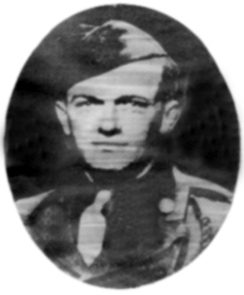
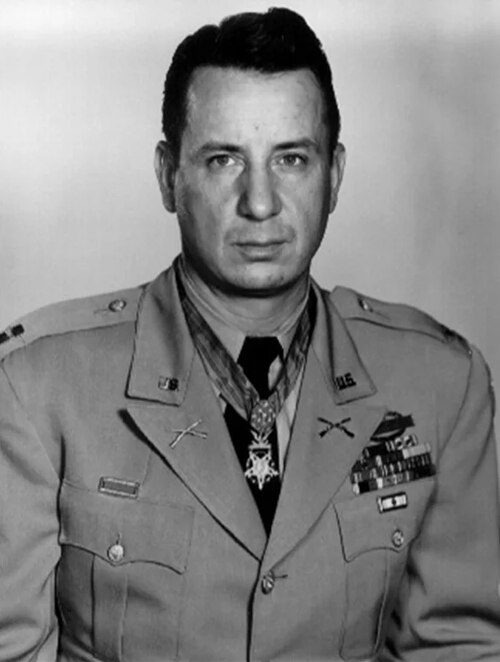
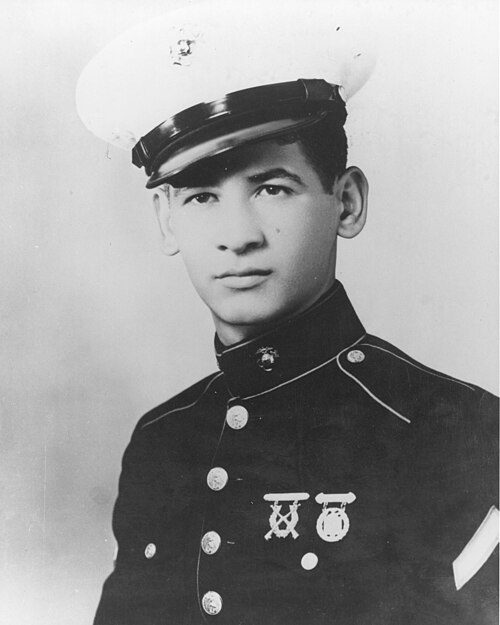
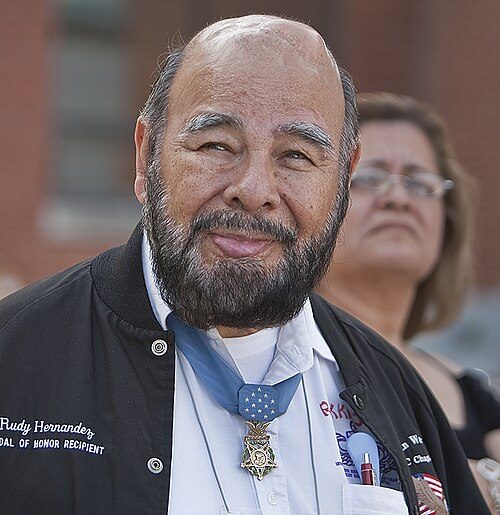
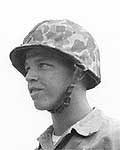
Major General William Frishe Dean Sr., a soldier in the U.S. Army, received the Medal of Honor for gallantry on July 20, 1950 in Taejon, Korea during the Korean War. At the time he was serving with 24th Infantry Division. Dean was 50 years old.
One other service member also received the Medal of Honor for actions on the same day. The medal was presented on January 9, 1951. White House, presented by Pres. Harry S. Truman to his Wife.
Dean was born on August 1, 1899 in Carlyle, Clinton County, Illinois. His Medal of Honor is credited to California. Dean died on August 24, 1981 in Berkeley, California, at the age of 82. He is buried at San Francisco National Cemetery in San Francisco, California.
Dean is one of 153 Medal of Honor recipients from the Korean War and one of 142 credited to California.
Official Medal of Honor citation
Maj. Gen. Dean distinguished himself by conspicuous gallantry and intrepidity at the repeated risk of his life above and beyond the call of duty. In command of a unit suddenly relieved from occupation duties in Japan and as yet untried in combat, faced with a ruthless and determined enemy, highly trained and overwhelmingly superior in numbers, he felt it his duty to take action which, to a man of his military experience and knowledge, was clearly apt to result in his death. He personally and alone attacked an enemy tank while armed only with a hand grenade. He also directed the fire of his tanks from an exposed position with neither cover nor concealment while under observed artillery and small-arms fire. When the town of Taejon was finally overrun he refused to ensure his own safety by leaving with the leading elements but remained behind organizing his retreating forces, directing stragglers, and was last seen assisting the wounded to a place of safety. These actions indicate that Maj. Gen. Dean felt it necessary to sustain the courage and resolution of his troops by examples of excessive gallantry committed always at the threatened portions of his front lines. The magnificent response of his unit to this willing and cheerful sacrifice, made with full knowledge of its certain cost, is history. The success of this phase of the campaign is in large measure due to Maj. Gen. Dean's heroic leadership, courageous and loyal devotion to his men, and his complete disregard for personal safety.
Citation text: U.S. Government, public domain.
Other decorations and honors
Besides the Medal of Honor, William Frishe Dean Sr. received:
Source: Wikidata. Gold chips link to our guide to that decoration.
Battles and campaigns
Also served in: World War II, Korean War.
Life beyond the battlefield
- Education: United States Military Academy
Source: Wikidata.
Places
Veteran resources, cemeteries and meeting places in California →
Timeline
- August 1, 1899Born in Carlyle, Clinton County, Illinois
- July 20, 1950Act of valor — Taejon, KoreaAge 50. 24th Infantry Division
- January 9, 1951Medal of Honor presentedWhite House, presented by Pres. Harry S. Truman to his Wife
- August 24, 1981Died in Berkeley, CaliforniaAge 82.
- Resting placeSan Francisco National CemeterySan Francisco, California
Biography
William Frishe Dean Sr. (August 1, 1899 – August 24, 1981) was a United States Army major general during World War II and the Korean War. He received the Medal of Honor for his actions on July 20 and 21, 1950 during the Battle of Daejon (Taejon) in South Korea. Dean also became the highest ranking American officer captured by an enemy force since the 18 American Army generals captured by Imperial Japan after the fall of the Philippines when he was captured by North Korea during the Korean War. Dean attended the University of California at Berkeley before graduating with a commission in the US Army through the Reserve Officer's Training Corps (ROTC) in 1921.
From the Wikipedia article “William F. Dean”, licensed under CC BY-SA 4.0. Read the full article →
Named in his honor
- General Dean Suspension Bridge — road bridge, suspension bridge