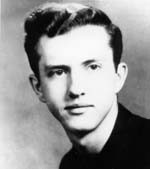
Major George Andrew Davis Jr. was an airman in the U.S. Air Force who was awarded the Medal of Honor posthumously for his actions on February 10, 1952 at Sinuiju-Yalu River area, Korea during the Korean War. At the time he was serving with 4th Fighter Group, 334th Fighter Squadron, 5th Air Force. Davis was 31 years old.
Davis was killed in the action for which his medal was awarded. The medal was presented on May 14, 1954, 2 years after the action. Reese Air Force Base, Texas, presented by Gen. Nathan F. Twining to his Widow Mrs. Doris L. Davis. He later rose to the rank of Lieutenant Colonel.
Davis was born on December 1, 1920 in Dublin, Erath County, Texas. His Medal of Honor is credited to Lubbock, Lubbock County, Texas. He is buried at National Memorial Cemetery of the Pacific in Hawaii.
Davis is one of 153 Medal of Honor recipients from the Korean War and one of 78 credited to Texas.
Official Medal of Honor citation
Maj. Davis distinguished himself by conspicuous gallantry and intrepidity at the risk of his life above and beyond the call of duty. While leading a flight of four F-86 Saberjets on a combat aerial patrol mission near the Manchurian border, Maj. Davis' element leader ran out of oxygen and was forced to retire from the flight with his wingman accompanying him. Maj. Davis and the remaining F-86s continued the mission and sighted a formation of approximately 12 enemy MIG-15 aircraft speeding southward toward an area where friendly fighter-bombers were conducting low-level operations against the Communist lines of communcations. With selfless disregard for the numerical superiority of the enemy, Maj. Davis positioned his two aircraft, then dove at the MIG formation. While speeding through the formation from the rear, he singled out a MIG-15 and destroyed it with a concentrated burst of fire. Although he was now under continuous fire from the enemy fighters to his rear, Maj. Davis sustained his attack. He fired at another MIG-15 which, bursting into smoke and flames, went into a vertical dive. Rather than maintain his superior speed and evade the enemy fire being concentrated on him, he elected to reduce his speed and sought out still a third MIG-15. During this latest attack his aircraft sustained a direct hit, went out of control, then crashed into a mountain 30 miles south of the Yalu River. Maj. Davis' bold attack completely disrupted the enemy formation, permitting the friendly fighter-bombers to successfully complete their interdiction mission. Maj. Davis, by his indomitable fighting spirit, heroic aggressiveness, and superb courage in engaging the enemy against formidable odds exemplified valor at its highest.
Citation text: U.S. Government, public domain.
Wounds and death in action
- Killed in action during the act for which the medal was awarded (February 10, 1952).
- Manner of death: death in battle
- Age at death: 31
- Resting place: National Memorial Cemetery of the Pacific
Cause and manner of death: Wikidata.
Other decorations and honors
Besides the Medal of Honor, George Andrew Davis Jr. received:
Source: Wikidata. Gold chips link to our guide to that decoration.
Battles and campaigns
Also served in: World War II, Korean War.
Life beyond the battlefield
- Occupations: air force officer
- Education: Harding University, Morton High School
Source: Wikidata.
Places
Timeline
- December 1, 1920Born in Dublin, Erath County, Texas
- February 10, 1952Act of valor — Sinuiju-Yalu River area, KoreaAge 31. 4th Fighter Group, 334th Fighter Squadron, 5th Air Force Killed in action.
- May 14, 1954Medal of Honor presented posthumouslyReese Air Force Base, Texas, presented by Gen. Nathan F. Twining to his Widow Mrs. Doris L. Davis
- Resting placeNational Memorial Cemetery of the PacificHawaii
Biography
George Andrew Davis Jr. (December 1, 1920 – February 10, 1952) was a highly decorated fighter pilot and flying ace of the United States Army Air Forces in World War II, and later of the United States Air Force during the Korean War. He was killed in action during a combat mission in northwestern Korea, in an area nicknamed "MiG Alley". For his actions during the Korean War, Davis was posthumously awarded the Medal of Honor and promoted from major to lieutenant colonel. Born in Dublin, Texas, Davis joined the United States Army Air Corps in early 1942.
From the Wikipedia article “George Andrew Davis Jr.”, licensed under CC BY-SA 4.0. Read the full article →