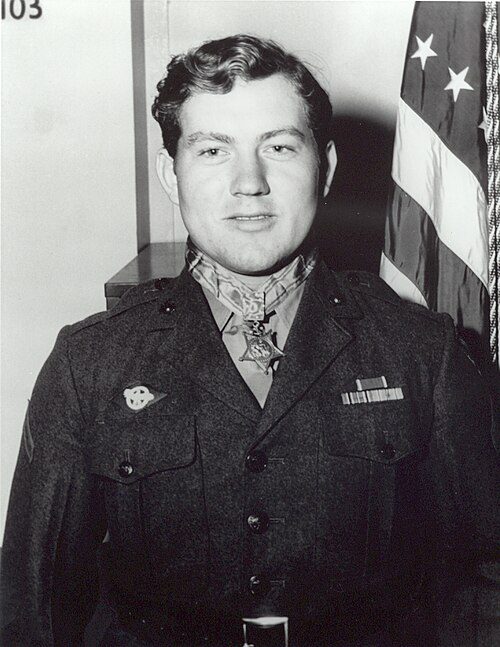
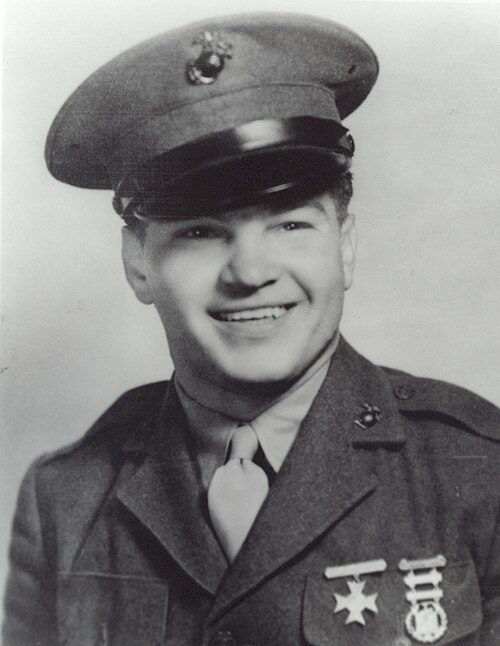
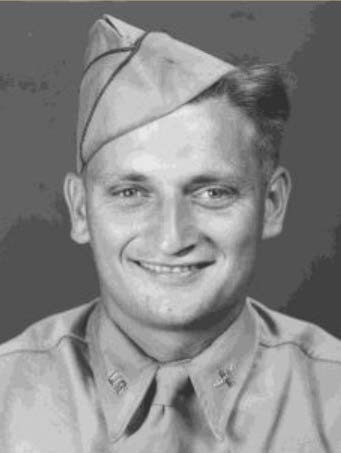
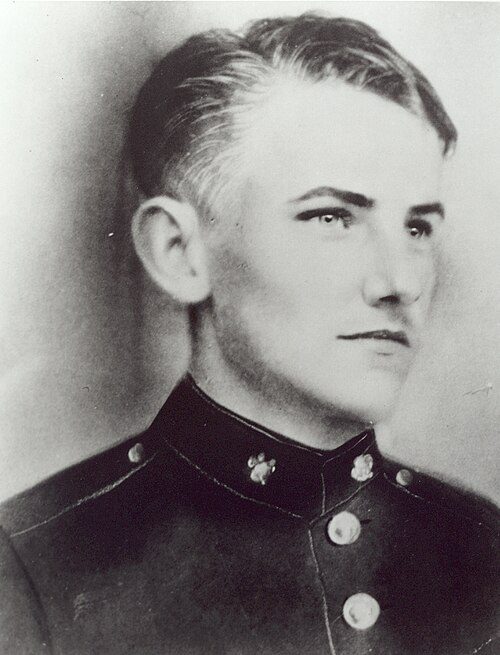
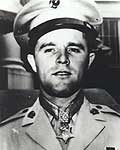
Serving as a Marine in the U.S. Marine Corps Reserve, Captain Robert Hugo Dunlap received the Medal of Honor for his actions between February 20 and 21, 1945 in Iwo Jima, Volcano Islands during World War II. At the time he was serving with Company C, 1st Battalion, 26th Marines, 5th Marine Division. Dunlap was 24 years old.
One other service member also received the Medal of Honor for actions on the same day. The medal was presented on December 18, 1945 — the White House, presented by Pres. Harry S. Truman. He later rose to the rank of Major.
Dunlap was born on October 19, 1920 in Abingdon, Knox County, Illinois. His Medal of Honor is credited to Monmouth, Warren County, Illinois. Dunlap died on March 24, 2000 in Monmouth, Illinois, at the age of 79. He is buried at Warren County Memorial Park in Monmouth, Illinois.
Dunlap is one of 474 Medal of Honor recipients from World War II and one of 210 credited to Illinois.
Official Medal of Honor citation
For conspicuous gallantry and intrepidity at the risk of his life above and beyond the call of duty as commanding officer of Company C, 1st Battalion, 26th Marines, 5th Marine division, in action against enemy Japanese forces during the seizure of Iwo Jima in the Volcano Islands on 20 and 21 February, 1945. Defying uninterrupted blasts of Japanese artillery, mortar, rifle, and machine-gun fire, Capt. Dunlap led his troops in a determined advance from low ground uphill toward the steep cliffs from which the enemy poured a devastating rain of shrapnel and bullets, steadily inching forward until the tremendous volume of enemy fire from the caves located high to his front temporarily halted his progress. Determined not to yield, he crawled alone approximately 200 yards forward of his front lines, took observation at the base of the cliff 50 yards from Japanese lines, located the enemy gun positions, and returned to his own lines where he relayed the vital information to supporting artillery and naval gunfire units. Persistently disregarding his own personal safety, he then placed himself in an exposed vantage point to direct more accurately the supporting fire and, working without respite for two days and two nights under constant enemy fire, skillfully directed a smashing bombardment against the almost impregnable Japanese positions despite numerous obstacles and heavy marine casualties. A brilliant leader, Capt. Dunlap inspired his men to heroic efforts during this critical phase of the battle and by his cool decision, indomitable fighting spirit, and daring tactics in the face of fanatic opposition greatly accelerated the final decisive defeat of Japanese countermeasures in his sector and materially furthered the continued advance of his company. His great personal valor and gallant spirit of self-sacrifice throughout the bitter hostilities reflect the highest credit upon Capt. Dunlap and the U.S. Naval Service.
Citation text: U.S. Government, public domain.
Other decorations and honors
Besides the Medal of Honor, Robert Hugo Dunlap received:
Source: Wikidata. Gold chips link to our guide to that decoration.
Battles and campaigns
Also served in: World War II.
Life beyond the battlefield
- Education: Monmouth College
Source: Wikidata.
Places
Veteran resources, cemeteries and meeting places in Illinois →
Timeline
- October 19, 1920Born in Abingdon, Knox County, Illinois
- February 20 - 21, 1945Act of valor — Iwo Jima, Volcano IslandsAge 24. Company C, 1st Battalion, 26th Marines, 5th Marine Division
- December 18, 1945Medal of Honor presentedThe White House, presented by Pres. Harry S. Truman
- March 24, 2000Died in Monmouth, IllinoisAge 79.
- Resting placeWarren County Memorial ParkMonmouth, Illinois
Biography
Robert Hugo Dunlap (October 19, 1920 – March 24, 2000) was a United States Marine Corps major who received the Medal of Honor for heroism above and beyond the call of duty as a captain of a rifle company during the Battle of Iwo Jima in World War II.
From the Wikipedia article “Robert Hugo Dunlap”, licensed under CC BY-SA 4.0. Read the full article →
Videos
Videos load from Vimeo only after you press play.