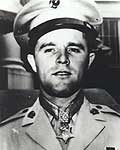
Technical Sergeant Russell Dunham was a soldier in the U.S. Army who received the Medal of Honor for his actions on January 8, 1945 in Kaysersberg, France during World War II. At the time he was serving with 2d Platoon, Company I, 3d Battalion, 30th Infantry, 3d Infantry Division. Dunham was 24 years old.
2 other service members also received the Medal of Honor for actions on the same day. The medal was presented on April 23, 1945. Zepman Stadium, Nuremberg, Germany, presented by Lt. Gen. Alexander M. Patch III.
Dunham was born on February 23, 1920 in East Carondelet, St. Clair County, Illinois. His Medal of Honor is credited to Brighton, Jersey County, Illinois. Dunham died on April 6, 2009 in Jerseyville, Illinois, at the age of 89. He is buried at Valhalla Memorial Park in Godfrey, Illinois.
Dunham is one of 474 Medal of Honor recipients from World War II and one of 210 credited to Illinois.
Official Medal of Honor citation
For conspicuous gallantry and intrepidity at risk of life above and beyond the call of duty. At about 1430 hours on 8 January 1945, during an attack on Hill 616, near Kaysersberg, France, TSgt. Dunham singlehandedly assaulted three enemy machine guns. Wearing a white robe made of a mattress cover, carrying 12 carbine magazines and with a dozen hand grenades snagged in his belt, suspenders, and buttonholes, TSgt. Dunham advanced in the attack up a snow-covered hill under fire from two machine guns and supporting riflemen. His platoon 35 yards behind him, TSgt. Dunham crawled 75 yards under heavy direct fire toward the timbered emplacement shielding the left machine gun. As he jumped to his feet 10 yards from the gun and charged forward, machine-gun fire tore through his camouflage robe and a rifle bullet seared a 10-inch gash across his back sending him spinning 15 yards downhill into the snow. When the indomitable sergeant sprang to his feet to renew his one-man assault, a German egg grenade landed beside him. He kicked it aside, and as it exploded five yards away, shot and killed the German machine gunner and assistant gunner. His carbine empty, he jumped into the emplacement and hauled out the third member of the gun crew by the collar. Although his back wound was causing him excruciating pain and blood was seeping through his white coat, TSgt. Dunham proceeded 50 yards through a storm of automatic and rifle fire to attack the second machine gun. Twenty-five yards from the emplacement he hurled two grenades, destroying the gun and its crew; then fired down into the supporting foxholes with his carbine, dispatching and dispersing the enemy riflemen. Although his coat was so thoroughly blood-soaked that he was a conspicuous target against the white landscape, TSgt. Dunham again advanced ahead of his platoon in an assault on enemy positions farther up the hill. Coming under machine-gun fire from 65 yards to his front, while rifle grenades exploded 10 yards from his position, he hit the ground and crawled forward. At 15 yards' range, he jumped to his feet, staggered a few paces toward the timbered machine- gun emplacement, and killed the crew with hand grenades. An enemy rifleman fired at point-blank range, but missed him. After killing the rifleman, TSgt. Dunham drove others from their foxholes with grenades and carbine fire. Killing nine Germans wounding seven and capturing two[--firing about 175 rounds of carbine ammunition, and expending 11 grenades, TSgt. Dunham, despite a painful wound, spearheaded a spectacular and successful diversionary attack.
Citation text: U.S. Government, public domain.
Wounds and injuries
What the citation records about his wounds:
Although his back wound was causing him excruciating pain and blood was seeping through his white coat, TSgt.
Coming under machine-gun fire from 65 yards to his front, while rifle grenades exploded 10 yards from his position, he hit the ground and crawled forward.
Dunham, despite a painful wound, spearheaded a spectacular and successful diversionary attack.
- Age at death: 89
- Resting place: Valhalla Memorial Park
Other decorations and honors
Besides the Medal of Honor, Russell Dunham received:
Source: Wikidata. Gold chips link to our guide to that decoration.
Battles and campaigns
Also served in: World War II.
Places
Veteran resources, cemeteries and meeting places in Illinois →
Timeline
- February 23, 1920Born in East Carondelet, St. Clair County, Illinois
- January 8, 1945Act of valor — Kaysersberg, FranceAge 24. 2d Platoon, Company I, 3d Battalion, 30th Infantry, 3d Infantry Division
- April 23, 1945Medal of Honor presentedZepman Stadium, Nuremberg, Germany, presented by Lt. Gen. Alexander M. Patch III
- April 6, 2009Died in Jerseyville, IllinoisAge 89.
- Resting placeValhalla Memorial ParkGodfrey, Illinois
Biography
Russell Dunham (February 23, 1920 – April 6, 2009) was an American World War II veteran and recipient of the Medal of Honor. On January 8, 1945, as a member of Company I, 30th Infantry, 3d Infantry Division, Dunham eliminated three German machine gun nests despite being injured himself.
From the Wikipedia article “Russell E. Dunham”, licensed under CC BY-SA 4.0. Read the full article →
Videos
Videos load from Vimeo only after you press play.