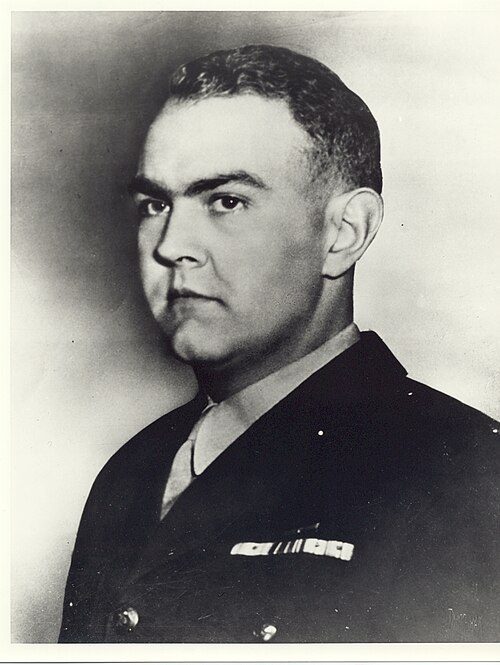
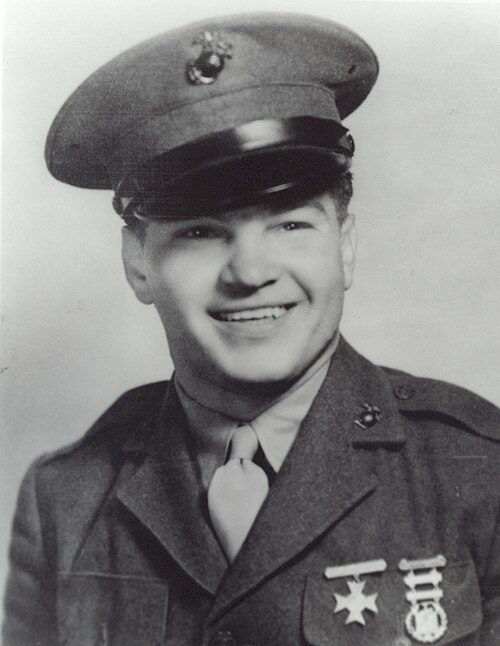
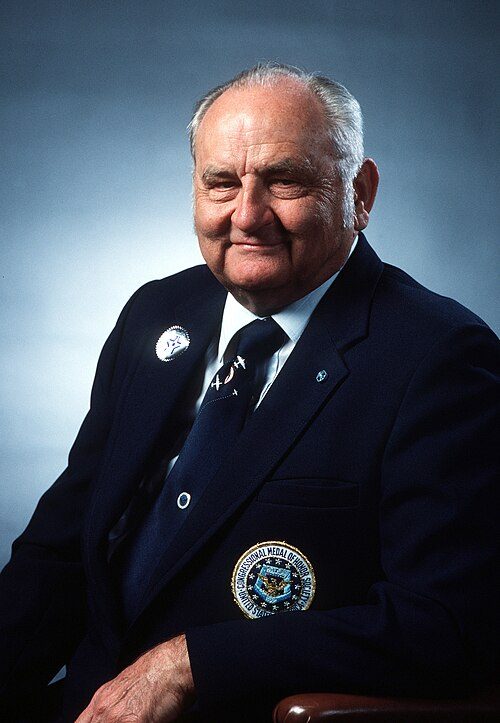
Major General James Lewis Day, a Marine in the U.S. Marine Corps, received the Medal of Honor for gallantry on May 17, 1945 in Okinawa, Ryukyu Islands during World War II. At the time he was serving with 2d Battalion, 22d Marines, 6th Marine Division. Day was 19 years old.
The medal was presented on January 20, 1998, 52 years after the action — the White House, presented by Pres. William J. Clinton.
Day was born on October 5, 1925 in East St. Louis, Saint Clair County, Illinois. Day died on October 28, 1998 in Cathedral City, California, at the age of 73. He is buried at Fort Rosecrans National Cemetery in San Diego, California.
Day is one of 474 Medal of Honor recipients from World War II and one of 210 credited to Illinois.
Official Medal of Honor citation
For conspicuous gallantry and intrepidity at the risk of his own life above and beyond the call of duty as a Squad Leader in sustained combat operations against Japanese forces. On the first day, Corporal Day rallied his squad and the remnants of another unit and led them to a critical position forward of the front lines of Sugar Loaf Hill. Soon thereafter, they came under an intense mortar and artillery barrage that was quickly followed by a ferocious ground attack by some forty Japanese soldiers. Despite the loss of one-half of his men, Corporal Day remained at the forefront, shouting encouragement, hurling hand grenades, and directing deadly fire, thereby repelling the determined enemy. Reinforced by six men, he led his squad in repelling three fierce night attacks but suffered five additional Marines killed and one wounded, whom he assisted to safety. Upon hearing nearby calls for corpsman assistance, Corporal Day braved heavy enemy fire to escort four seriously wounded Marines, one at a time, to safety. Corporal Day then manned a light machine gun, assisted by a wounded Marine, and halted another night attack. In this ferocious action, his machine gun was destroyed, and he suffered multiple white phosphorous and fragmentation wounds. He reorganized his defensive position in time to halt a fifth enemy attack with devastating small arms fire. On three separate occasions, Japanese soldiers closed to within a few feet of his foxhole, but were killed by Corporal Day. During the second day, the enemy conducted numerous unsuccessful swarming attacks against his exposed position. When the attacks momentarily subsided, over 70 enemy dead were counted around his position. On the third day, a wounded and exhausted Corporal Day repulsed the enemy's final attack, killing a dozen enemy soldiers at close range. Having yielded no ground and with more than 100 enemy dead around his position, Corporal Day preserved the lives of his fellow Marines and made a significant contribution to the success of the Okinawa campaign. By his extraordinary heroism, repeated acts of valor, and quintessential battlefield leadership, Corporal Day inspired the efforts of his outnumbered Marines to defeat a much larger enemy force, reflecting great credit upon himself and upholding the highest tradations of the Marine Corps and the United States Naval Service.
Citation text: U.S. Government, public domain.
Wounds and injuries
What the citation records about his wounds:
Reinforced by six men, he led his squad in repelling three fierce night attacks but suffered five additional Marines killed and one wounded, whom he assisted to safety.
In this ferocious action, his machine gun was destroyed, and he suffered multiple white phosphorous and fragmentation wounds.
On the third day, a wounded and exhausted Corporal Day repulsed the enemy's final attack, killing a dozen enemy soldiers at close range.
- Age at death: 73
- Resting place: Fort Rosecrans National Cemetery
Other decorations and honors
Besides the Medal of Honor, James Lewis Day received:
Source: Wikidata. Gold chips link to our guide to that decoration.
Battles and campaigns
Also served in: World War II.
Places
Veteran resources, cemeteries and meeting places in Illinois →
Timeline
- October 5, 1925Born in East St. Louis, Saint Clair County, Illinois
- May 17, 1945Act of valor — Okinawa, Ryukyu IslandsAge 19. 2d Battalion, 22d Marines, 6th Marine Division
- January 20, 1998Medal of Honor presentedThe White House, presented by Pres. William J. Clinton
- October 28, 1998Died in Cathedral City, CaliforniaAge 73.
- Resting placeFort Rosecrans National CemeterySan Diego, California
Biography
Major General James Lewis Day (October 5, 1925 – October 28, 1998) was a United States Marine Corps major general who served in World War II, in the Korean War, and in the Vietnam War. He was awarded the Medal of Honor for his heroic actions as a corporal on May 14 to 17, 1945 during the Battle of Okinawa in World War II. Upon awarding him the Medal of Honor, President Clinton said:During a career that spanned more than four decades, he rose from enlisted man through the ranks to major general, becoming one of the greatest mustangs the Marine Corps ever produced. In Korea, his valor in combat was recognized with two Silver Stars.
From the Wikipedia article “James L. Day”, licensed under CC BY-SA 4.0. Read the full article →