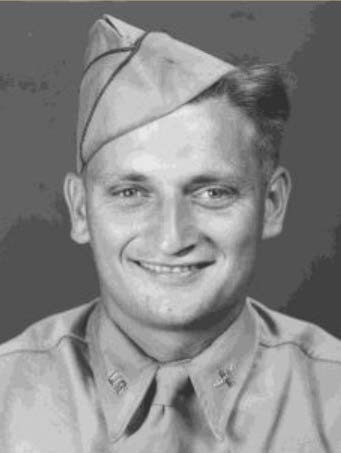
First Lieutenant Edward Stanley Michael was an airman in the U.S. Army Air Corps who received the Medal of Honor for his actions on April 11, 1944 over Stettin, Germany during World War II. At the time he was serving with 364th Bombardment Squadron, 305th Bombardment Group, 40th Combat Wing, 2d Air Division, 8th Air Force. Michael was 25 years old.
The medal was presented on January 10, 1945 — the White House, presented by Pres. Franklin D. Roosevelt. He later rose to the rank of Lieutenant Colonel.
Michael was born on May 2, 1918 in Chicago, Cook County, Illinois. Michael died on May 10, 1994 in Fairfield, California, at the age of 76. He is buried at Evergreen Cemetery in Springfield, Utah. His medal is held by Travis Air Force Base Museum, Travis Air Force Base, TX.
Michael is one of 474 Medal of Honor recipients from World War II and one of 210 credited to Illinois.
Official Medal of Honor citation
For conspicuous gallantry and intrepidity above and beyond the call of duty while serving as pilot of a B-17 aircraft on a heavy-bombardment mission to Germany, 11 April 1944. The group in which 1st Lt. Michael was flying was attacked by a swarm of fighters. His plane was singled out and the fighters pressed their attacks home recklessly, completely disregarding the Allied fighter escort and their own intensive flak. His plane was riddled from nose to tail with exploding cannon shells and knocked out of formation, with a large number of fighters following it down, blasting it with cannon fire as it descended. A cannon shell exploded in the cockpit, wounded the copilot, wrecked the instruments, and blew out the side window. First Lt. Michael was seriously and painfully wounded in the right thigh. Hydraulic fluid filmed over the windshield making visibility impossible, and smoke filled the cockpit. The controls failed to respond and 3,000 feet were lost before he succeeded in leveling off. The radio operator informed him that the whole bomb bay was in flames as a result of the explosion of three cannon shells, which had ignited the incendiaries. With a full load of incendiaries in the bomb bay and a considerable gas load in the tanks, the danger of fire enveloping the plane and the tanks exploding seemed imminent. When the emergency release lever failed to function, 1st Lt. Michael at once gave the order to bail out and seven of the crew left the plane. Seeing the bombardier firing the navigator's gun at the enemy planes, 1st Lt. Michael ordered him to bail out as the plane was liable to explode any minute. When the bombardier looked for his parachute he found that it had been riddled with 20-mm fragments and was useless. First Lt. Michael, seeing the ruined parachute, realized that if the plane was abandoned the bombardier would perish and decided that the only chance would be a crash landing. Completely disregarding his own painful and profusely bleeding wounds, but thinking only of the safety of the remaining crewmembers, he gallantly evaded the enemy using violent evasive action despite the battered condition of his plane. After the plane had been under sustained enemy attack for fully 45 minutes, 1st Lt. Michael finally lost the persisent fighters in a cloud bank. Upon emerging, an accurate barrage of flak caused him to come down to treetop level where flak towers poured a continuous rain of fire on the plane. He continued into France, realizing that at any moment a crash landing might have to be attempted, but trying to get as far as possible to increase the escape possibilities if a safe landing could be achieved. First Lt. Michael flew the plane until he became exhausted from loss of blood, which had formed on the floor in pools, and he lost consciousness. The copilot succeeded in reaching England and sighted an RAF field near the coast. First Lt. Michael finally regained consciousness and insisted upon taking over the controls to land the plane. The undercarriage was useless; the bomb bay doors were jammed open; the hydraulic system and altimeter were shot out. In addition, there was no airspeed indicator, the ball turret was jammed with the guns pointing downward, and the flaps would not respond. Despite these apparently insurmountable obstacles, he landed the plane without mishap.
Citation text: U.S. Government, public domain.
Other decorations and honors
Besides the Medal of Honor, Edward Stanley Michael received:
Source: Wikidata. Gold chips link to our guide to that decoration.
Battles and campaigns
Also served in: World War II.
Life beyond the battlefield
- Education: Air University
Source: Wikidata.
Places
Veteran resources, cemeteries and meeting places in Illinois →
Timeline
- May 2, 1918Born in Chicago, Cook County, Illinois
- April 11, 1944Act of valor — over Stettin, GermanyAge 25. 364th Bombardment Squadron, 305th Bombardment Group, 40th Combat Wing, 2d Air Division, 8th Air Force
- January 10, 1945Medal of Honor presentedThe White House, presented by Pres. Franklin D. Roosevelt
- May 10, 1994Died in Fairfield, CaliforniaAge 76.
- Resting placeEvergreen CemeterySpringfield, Utah
Biography
Edward Stanley Michael (May 2, 1918 – May 10, 1994) was a United States Army Air Forces officer and a recipient of the United States military's highest decoration—the Medal of Honor—for his actions in World War II.
From the Wikipedia article “Edward S. Michael”, licensed under CC BY-SA 4.0. Read the full article →