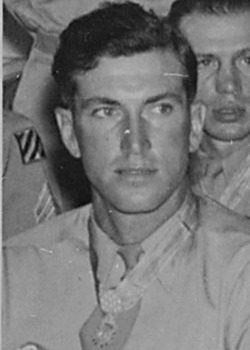
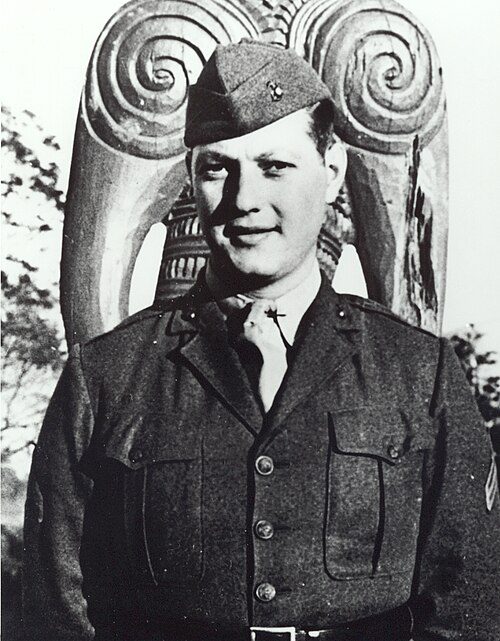
Serving as a soldier in the U.S. Army, Lieutenant Colonel George Lafayette Mabry Jr. received the Medal of Honor for his actions on November 20, 1944 in Hurtgen Forest near Schevenhutte, Germany during World War II. At the time he was serving with 2d Battalion, 8th Infantry, 4th Infantry Division. Mabry was 27 years old.
One other service member also received the Medal of Honor for actions on the same day. The medal was presented on August 23, 1945 — the White House, presented by Pres. Harry S. Truman. He later rose to the rank of Major General.
Mabry was born on September 14, 1917 in Sumter, Sumter County, South Carolina. Mabry died on July 13, 1990 in Columbia, South Carolina, at the age of 72. He is buried at Holy Cross Episcopal Church Cemetery in Statesboro, South Carolina.
Mabry is one of 474 Medal of Honor recipients from World War II and one of 33 credited to South Carolina.
Official Medal of Honor citation
He was commanding the 2d Battalion, 8th Infantry, in an attack through the Hurtgen Forest near Schevenhutte, Germany, on 20 November 1944. During the early phases of the assault, the leading elements of his battalion were halted by a minefield and immobilized by heavy hostile fire. Advancing alone into the mined area, Col. Mabry established a safe route of passage. He then moved ahead of the foremost scouts, personally leading the attack, until confronted by a booby-trapped double concertina obstacle. With the assistance of the scouts, he disconnected the explosives and cut a path through the wire. Upon moving through the opening, he observed three enemy in foxholes whom he captured at bayonet point. Driving steadily forward he paced the assault against three log bunkers which housed mutually supported automatic weapons. Racing up a slope ahead of his men, he found the initial bunker deserted, then pushed on to a second where he was suddenly confronted by nine onrushing enemy. Using the butt of his rifle, he felled one adversary and bayoneted a second, before his scouts came to his aid and assisted him in overcoming the others in hand-to-hand combat. Accompanied by the riflemen, he charged the third bunker under point-blank small-arms fire and led the way into the fortification from which he prodded six enemy at bayonet point. Following the consolidation of this area, he led his battalion across 300 yards of fire-swept terrain to seize elevated ground upon which he established a defensive position which menaced the enemy on both flanks, and provided his regiment a firm foothold on the approach to the Cologne Plain. Col. Mabry's superlative courage, daring, and leadership in an operation of major importance exemplify the finest characteristics of the military service.
Citation text: U.S. Government, public domain.
Other decorations and honors
Besides the Medal of Honor, George Lafayette Mabry Jr. received:
Source: Wikidata. Gold chips link to our guide to that decoration.
Battles and campaigns
Battle of Hürtgen Forest
Result: German victory
3 Medal of Honor recipients
1944 · World War IIInvasion of Normandy
Result: Allied victory
3 Medal of Honor recipients
Also served in: World War II.
Life beyond the battlefield
- Education: Presbyterian College
Source: Wikidata.
Places
Veteran resources, cemeteries and meeting places in South Carolina →
Timeline
- September 14, 1917Born in Sumter, Sumter County, South Carolina
- November 20, 1944Act of valor — Hurtgen Forest near Schevenhutte, GermanyAge 27. 2d Battalion, 8th Infantry, 4th Infantry Division
- August 23, 1945Medal of Honor presentedThe White House, presented by Pres. Harry S. Truman
- July 13, 1990Died in Columbia, South CarolinaAge 72.
- Resting placeHoly Cross Episcopal Church CemeteryStatesboro, South Carolina
Biography
George Lafayette Mabry Jr. (September 14, 1917 – July 13, 1990) was a United States Army major general and a recipient of the United States military's highest decoration for valor—the Medal of Honor—for heroism above and beyond the call of duty on 20 November 1944, during the Battle of Hurtgen Forest in World War II.
From the Wikipedia article “George L. Mabry Jr.”, licensed under CC BY-SA 4.0. Read the full article →