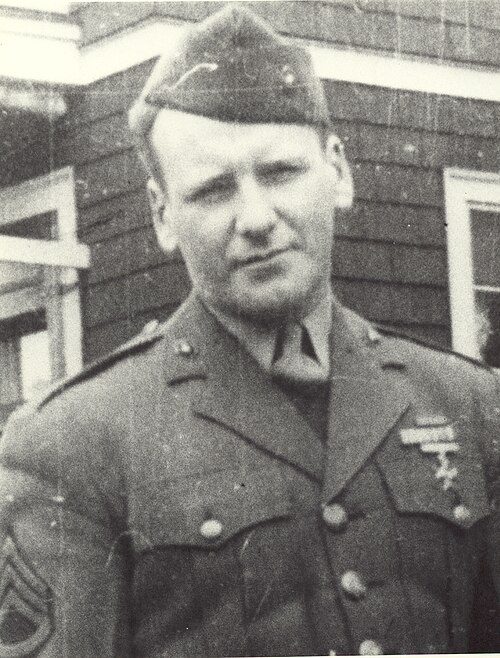
Corporal Edward G. Wilkin was a soldier in the U.S. Army who was awarded the Medal of Honor posthumously for his actions on March 18, 1945 in Siegfried Line, Germany during World War II. At the time he was serving with Company C, 157th Infantry, 45th Infantry Division. Wilkin was 27 years old.
3 other service members also received the Medal of Honor for actions on the same day.
Wilkin was born on May 25, 1917 in Burlington, Chittenden County, Vermont. His Medal of Honor is credited to Longmeadow, Hampden County, Massachusetts. Wilkin died on April 18, 1945 in Europe, at the age of 27. He is buried at Longmeadow Cemetery in Longmeadow, Massachusetts. His medal is held by Longmeadow Historical Society, Longmeadow, MA.
Wilkin is one of 474 Medal of Honor recipients from World War II and one of 265 credited to Massachusetts.
Official Medal of Honor citation
He spearheaded his unit's assault of the Siegfried line in Germany. Heavy fire from enemy riflemen and camouflaged pillboxes had pinned down his comrades when he moved forward on his own initiative to reconnoiter a route of advance. He cleared the way into an area studded with pillboxes, where he repeatedly stood up and walked into vicious enemy fire, storming one fortification after another with automatic rifle fire and grenades, killing enemy troops, taking prisoners as the enemy defense became confused, and encouraging his comrades by his heroic example. When halted by heavy barbed wire entanglements, he secured bangalore torpedoes and blasted a path toward still more pillboxes, all the time braving bursting grenades and mortar shells and direct rifle and automatic-weapon fire. He engaged in fierce firefights, standing in the open while his adversaries fought from the protection of concrete emplacements, and on one occasion pursued enemy soldiers across an open field and through interlocking trenches, disregarding the crossfire from two pillboxes until he had penetrated the formidable line 200 yards in advance of any American element. That night, although terribly fatigued, he refused to rest and insisted on distributing rations and supplies to his comrades. Hearing that a nearby company was suffering heavy casualties, he secured permission to guide litter bearers and assist them in evacuating the wounded. All that night he remained in the battle area on his mercy missions, and for the following two days he continued to remove casualties, venturing into enemy-held territory, scorning cover, and braving devastating mortar and artillery bombardments. In three days he neutralized and captured six pillboxes singlehandedly, killed at least nine Germans, wounded 13, took 13 prisoners, aided in the capture of 14 others, and saved many American lives by his fearless performance as a litter bearer. Through his superb fighting skill, dauntless courage, and gallant, inspiring actions, Cpl. Wilkin contributed in large measure to his company's success in cracking the Siegfried line. One month later he was killed in action while fighting deep in Germany.
Citation text: U.S. Government, public domain.
Battles and campaigns
Also served in: World War II.
Places
Veteran resources, cemeteries and meeting places in Massachusetts →
Timeline
- May 25, 1917Born in Burlington, Chittenden County, Vermont
- March 18, 1945Act of valor — Siegfried Line, GermanyAge 27. Company C, 157th Infantry, 45th Infantry Division
- April 18, 1945Died in EuropeAge 27.
- Resting placeLongmeadow CemeteryLongmeadow, Massachusetts
Biography
Edward G. Wilkin (May 25, 1917 – April 18, 1945) was a United States Army soldier who was a recipient of the Medal of Honor — the United States military's highest decoration — for his actions fighting in World War II. Working ahead of his unit he engaged German forces single-handedly and then aided another unit in clearing casualties to safety in the face of enemy fire. He was killed a month later.
From the Wikipedia article “Edward G. Wilkin”, licensed under CC BY-SA 4.0. Read the full article →