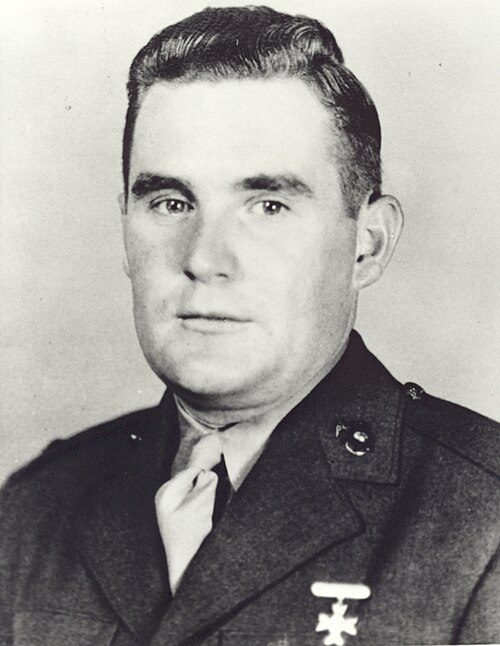
Serving as a soldier in the U.S. Army, Sergeant Charles Andrew MacGillivary received the Medal of Honor for his actions on January 1, 1945 near Woelfling, France during World War II. At the time he was serving with Company I, 463d Battalion, 71st Infantry, 44th Infantry Division. MacGillivary was 27 years old.
The medal was presented on August 23, 1945 — the White House, presented by Pres. Harry S. Truman. He later rose to the rank of Technical Sergeant.
MacGillivary was born on January 7, 1917 in Charlottetown, Canada — one of 60 recipients born in Canada. His Medal of Honor is credited to Boston, Suffolk County, Massachusetts. MacGillivary died on June 24, 2000 in Brockton, Massachusetts, at the age of 83. He is buried at Arlington National Cemetery in Arlington, Virginia.
MacGillivary is one of 474 Medal of Honor recipients from World War II and one of 265 credited to Massachusetts.
Official Medal of Honor citation
He led a squad when his unit moved forward in darkness to meet the threat of a breakthrough by elements of the 17th German Panzer Grenadier Division. Assigned to protect the left flank, he discovered hostile troops digging in. As he reported this information, several German machine guns opened fire, stopping the American advance. Knowing the position of the enemy, Sgt. MacGillivary volunteered to knock out one of the guns while another company closed in from the right to assault the remaining strongpoints. He circled from the left through woods and snow, carefully worked his way to the emplacement, and shot the two camouflaged gunners at a range of three feet as other enemy forces withdrew. Early in the afternoon of the same day, Sgt. MacGillivary was dispatched on reconnaissance and found that Company I was being opposed by about six machine guns reinforcing a company of fanatically fighting Germans. His unit began to attack but was pinned down by furious automatic and small-arms fire. With a clear idea of where the enemy guns were placed, he voluntarily embarked on a lone combat patrol. Skillfully taking advantage of all available cover, he stalked the enemy, reached a hostile machine gun, and blasted its crew with a grenade. He picked up a submachine gun from the battlefield and pressed on to within 10 yards of another machine gun, where the enemy crew discovered him and feverishly tried to swing their weapon into line to cut him down. He charged ahead, jumped into the midst of the Germans, and killed them with several bursts. Without hesitation, he moved on to still another machine gun, creeping, crawling, and rushing from tree to tree, until close enough to toss a grenade into the emplacement and close with its defenders. He dispatched this crew also, but was himself seriously wounded. Through his indomitable fighting spirit, great initiative, and utter disregard for personal safety in the face of powerful enemy resistance, Sgt. MacGillivary destroyed four hostile machine guns and immeasurably helped his company to continue on its mission with minimum casualties.
Citation text: U.S. Government, public domain.
Other decorations and honors
Besides the Medal of Honor, Charles Andrew MacGillivary received:
Source: Wikidata. Gold chips link to our guide to that decoration.
Battles and campaigns
Also served in: World War II.
Places
Veteran resources, cemeteries and meeting places in Massachusetts →
Timeline
- January 7, 1917Born in Charlottetown, Canada
- January 1, 1945Act of valor — near Woelfling, FranceAge 27. Company I, 463d Battalion, 71st Infantry, 44th Infantry Division
- August 23, 1945Medal of Honor presentedThe White House, presented by Pres. Harry S. Truman
- June 24, 2000Died in Brockton, MassachusettsAge 83.
- Resting placeArlington National CemeteryArlington, Virginia
Biography
Charles Andrew MacGillivary (January 17, 1917 – June 24, 2000) was a Medal of Honor recipient, born in Charlottetown, Prince Edward Island, Canada. A sergeant in the United States Army, he was attached to Company I, 71st Infantry, 44th Infantry Division during World War II.
From the Wikipedia article “Charles Andrew MacGillivary”, licensed under CC BY-SA 4.0. Read the full article →