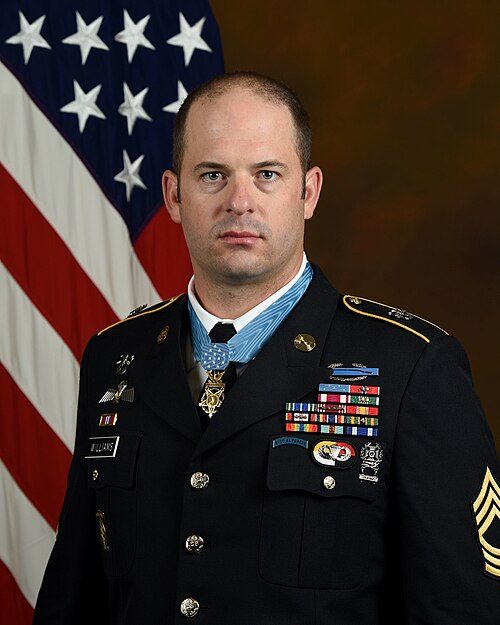
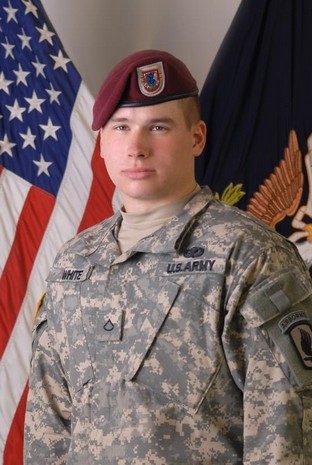
Serving as a soldier in the U.S. Army, Staff Sergeant Ronald J. Shurer II received the Medal of Honor for his actions on April 6, 2008 at Shok Valley, Nuristan Province, Afghanistan during the war in Afghanistan. At the time he was serving with Operational Detachment Alpha 3336 (ODA-3336), 3d Special Forces Group (Airborne), Special Operations Task Force 33, Combined Joint Special Operations Task Force - Afghanistan. Shurer was 29 years old.
One other service member also received the Medal of Honor for actions on the same day. The medal was presented on October 1, 2018, 10 years after the action — at the White House, Washington, D.C., by President Donald J. Trump.
Shurer was born on December 7, 1978 in Fairbanks, Alaska. His Medal of Honor is credited to Spokane, Spokane County, Washington. Shurer died on May 14, 2020 in Washington, District of Columbia, at the age of 41. He is buried at Arlington National Cemetery in Arlington, Virginia.
Shurer is one of 22 Medal of Honor recipients from the war in Afghanistan and one of 40 credited to Washington.
Official Medal of Honor citation
Staff Sergeant Ronald J. Shurer II distinguished himself by acts of gallantry and intrepidity above and beyond the call of duty on April 6, 2008, while serving as a Senior Medical Sergeant, Special Forces Operational Detachment Alpha 3336, Special Operations Task Force-33, in support of Operation Enduring Freedom. Staff Sergeant Shurer was part of an assault element inserted by helicopter into a location in Afghanistan. As the assault element moved up a near vertical mountain toward its objective, it was engaged by fierce enemy machine gun, sniper, and rocket-propelled grenade fire. The lead portion of the assault element, which included the ground commander, sustained several casualties and became pinned down on the mountainside. Staff Sergeant Shurer and the rest of the trailing portion of the assault element were likewise engaged by enemy machine gun, sniper, and rocket-propelled grenade fire. As the attack intensified, Staff Sergeant Shurer braved enemy fire to move to an injured Soldier and treat his wounds. Having stabilized the injured Soldier, Staff Sergeant Shurer then learned of the casualties among the lead element. Staff Sergeant Shurer fought his way up the mountainside, under intense enemy fire, to the lead element’s location. Upon reaching the lead element, he treated and stabilized two more Soldiers. Finishing those lifesaving efforts, Staff Sergeant Shurer noticed two additional severely wounded Soldiers under intense enemy fire. The bullet that had wounded one of these Soldiers had also impacted Staff Sergeant Shurer’s helmet. With complete disregard for his own life, Staff Sergeant Shurer again moved through enemy fire to treat and stabilize one Soldier’s severely wounded arm. Shortly thereafter, Staff Sergeant Shurer continued to brave withering enemy fire to get to the other Soldier’s location in order to treat his lower leg, which had been almost completely severed by a high-caliber sniper round. After treating the Soldier, Staff Sergeant Shurer began to evacuate the wounded; carrying and lowering them down the sheer mountainside. While moving down the mountain, Staff Sergeant Shurer used his own body to shield the wounded from enemy fire and debris caused by danger-close air strikes. Reaching the base of the mountain, Staff Sergeant Shurer set up a casualty collection point and continued to treat the wounded. With the arrival of the medical evacuation helicopter, Staff Sergeant Shurer, again under enemy fire, helped load the wounded into the helicopter. Having ensured the safety of the wounded, Staff Sergeant Shurer then regained control of his commando squad and rejoined the fight. He continued to lead his troops and emplace security elements until it was time to move to the evacuation landing zone for the helicopter. Staff Sergeant Shurer’s actions are in keeping with the finest traditions of military service and reflect great credit upon himself, Combined Joint Special Operations Task Force-Afghanistan, Special Operations Command Central, and the United States Army.
Citation text: U.S. Government, public domain.
Wounds and injuries
What the citation records about his wounds:
Shortly thereafter, Staff Sergeant Shurer continued to brave withering enemy fire to get to the other Soldier’s location in order to treat his lower leg, which had been almost completely severed by a high-caliber sniper round.
While moving down the mountain, Staff Sergeant Shurer used his own body to shield the wounded from enemy fire and debris caused by danger-close air strikes.
- Age at death: 41
- Resting place: Arlington National Cemetery
Life beyond the battlefield
Source: Wikidata.
Places
Veteran resources, cemeteries and meeting places in Washington →
Timeline
- December 7, 1978Born in Fairbanks, Alaska
- April 6, 2008Act of valor — Shok Valley, Nuristan Province, AfghanistanAge 29. Operational Detachment Alpha 3336 (ODA-3336), 3d Special Forces Group (Airborne), Special Operations Task Force 33, Combined Joint Special Operations Task Force - Afghanistan
- October 1, 2018Medal of Honor presentedAt the White House, Washington, D.C., by President Donald J. Trump
- May 14, 2020Died in Washington, District of ColumbiaAge 41.
- Resting placeArlington National CemeteryArlington, Virginia
Biography
Ronald Joseph Shurer II (December 7, 1978 – May 14, 2020) was a United States Army Special Forces staff sergeant and medic. As a senior medical sergeant during the Battle of Shok Valley in April 2008, he and his team were attacked by an enemy force of more than 200 fighters. Shurer fought for more than an hour to reach part of his unit, killing several insurgents along the way. He was initially awarded a Silver Star for this action, but in 2016 The Pentagon upgraded this recognition to a Medal of Honor. He received the latter honor in a White House ceremony on October 1, 2018.
From the Wikipedia article “Ronald J. Shurer”, licensed under CC BY-SA 4.0. Read the full article →
Videos
Videos load from Vimeo only after you press play.
Further reading
- Continuing Service: Law Enforcement Medal of Honor Recipientscmohs.org · 2022
- Ronald J. Shurer II Passed Away Due to Lung Cancercmohs.org · 2020
- ‘Find a way to serve.’ | Dear Young American: Ron Shurermilitarytimes.com · 2021
- "Find a way to serve" | Dear Young American — Ron Shurerarmytimes.com · 2021
- 'An Unprecedented Man:' Medal of Honor Recipient Ron Shurer Laid to Rest at Arlingtonmilitary.com · 2020