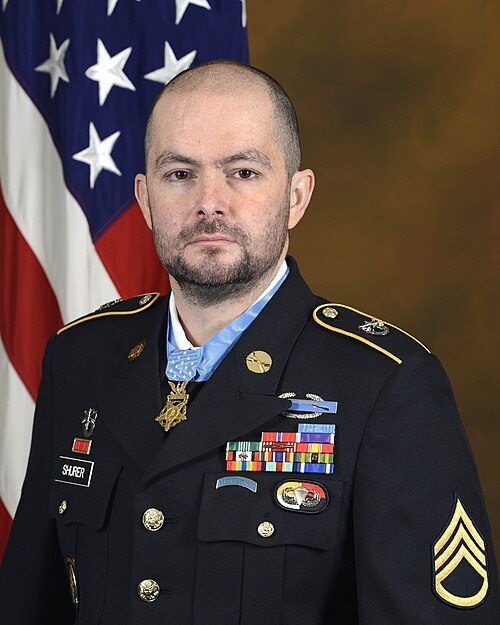
Serving as a soldier in the U.S. Army, Sergeant Matthew O. Williams received the Medal of Honor for his actions on April 6, 2008 at Shok Valley, Nuristan Province, Afghanistan during the war in Afghanistan. At the time he was serving with Operational Detachment Alpha 3336, Company C, 3rd Battalion, Special Operations Task Force-33, Combined Joint Special Operations Task Force - Afghanistan. Williams was 26 years old.
One other service member also received the Medal of Honor for actions on the same day. The medal was presented on October 30, 2019, 11 years after the action — at the White House by President Donald J. Trump. He later rose to the rank of Command Sergeant Major.
Williams was born on October 3, 1981 in Casper, Natrona County, Wyoming. His Medal of Honor is credited to Houston, Harris County, Texas. Williams is one of the living Medal of Honor recipients.
Williams is one of 22 Medal of Honor recipients from the war in Afghanistan and one of 78 credited to Texas.
Official Medal of Honor citation
Sergeant Matthew O. Williams distinguished himself by acts of gallantry and intrepidity above and beyond the call of duty on April 6, 2008, while serving as a Weapons Sergeant, Special Forces Operational Detachment Alpha 3336, Special Operations Task Force-33, in support of Operation ENDURING FREEDOM. Sergeant Williams was part of an assault element inserted by helicopter into a location in Afghanistan. As the assault element was moving up a mountain toward its objective, it was engaged by intense enemy machine gun, sniper, and rocket-propelled grenade fire. The lead portion of the assault element, which included the ground commander, sustained several casualties and became pinned down on the sheer mountainside. Sergeant Williams, upon hearing that the lead element had sustained casualties and was in danger of being overrun, braved intense enemy fire to lead a counter-attack across a valley of ice-covered boulders and a fast-moving, ice cold, and waist-deep river. Under withering fire, Sergeant Williams and his local national commandos fought up the terraced mountainside to the besieged element. Arriving at the lead element’s position, Sergeant Williams arrayed his Afghan commandos to provide suppressive fire, which kept the insurgent fighters from overrunning the position. When the Team Sergeant was wounded, Sergeant Williams braved enemy fire once again to provide buddy-aid and to move the Team Sergeant down the sheer mountainside to the casualty collection point. Sergeant Williams then fought and climbed his way back up the mountainside to help defend the lead assault element that still had several serious casualties in need of evacuation. Sergeant Williams directed suppressive fire and exposed himself to enemy fire in order to reestablish the team’s critical satellite radio communications. He then assisted with moving the wounded down the near-vertical mountainside to the casualty collection point. Noting that the collection point was about to be overrun by enemy fighters, Sergeant Williams led the Afghan commandos in a counter-attack that lasted for several hours. When helicopters arrived to evacuate the wounded, Sergeant Williams again exposed himself to enemy fire, carrying and loading casualties onto the helicopters while continuing to direct commando firepower to suppress numerous insurgent positions. His actions enabled the patrol to evacuate wounded and dead comrades without further casualties. Sergeant Williams’ complete disregard for his own safety and his concern for the safety of his teammates ensured the survival of four critically wounded soldiers and prevented the lead element of the assault force from being overrun by the enemy. Sergeant Williams' actions are in keeping with the finest traditions of military service and reflect great credit upon himself, Combined Joint Special Operations Task Force-Afghanistan, Special Operations Command Central, and the United States Army.
Citation text: U.S. Government, public domain.
Other decorations and honors
Besides the Medal of Honor, Matthew O. Williams received:
Source: Wikidata. Gold chips link to our guide to that decoration.
Battles and campaigns
Also served in: War in Afghanistan (2001–2021), Battle of Shok Valley.
Life beyond the battlefield
- Education: Angelo State University
Source: Wikidata.
Places
- Born: Boerne — map
Timeline
- October 3, 1981Born in Casper, Natrona County, Wyoming
- April 6, 2008Act of valor — Shok Valley, Nuristan Province, AfghanistanAge 26. Operational Detachment Alpha 3336, Company C, 3rd Battalion, Special Operations Task Force-33, Combined Joint Special Operations Task Force - Afghanistan
- October 30, 2019Medal of Honor presentedAt the White House by President Donald J. Trump
Biography
Matthew O. Williams (born October 3, 1981) is a retired sergeant major in the United States Army. He received the Medal of Honor (upgraded from a Silver Star) on October 30, 2019, for his actions as a sergeant on April 6, 2008, as a member of Operational Detachment Alpha 3336, Special Operations Task Force 11, Combined Joint Special Operations Task Force-Afghanistan in the Battle of Shok Valley.
From the Wikipedia article “Matthew O. Williams”, licensed under CC BY-SA 4.0. Read the full article →
Videos
Videos load from Vimeo only after you press play.
Further reading
- Welcoming the 2024-2026 CMOHS Board of Directorscmohs.org · 2023
- Veterans Day – Honoring Those Who Have Servedcmohs.org · 2020
- Interview with Matthew Williamscmohs.org · 2020