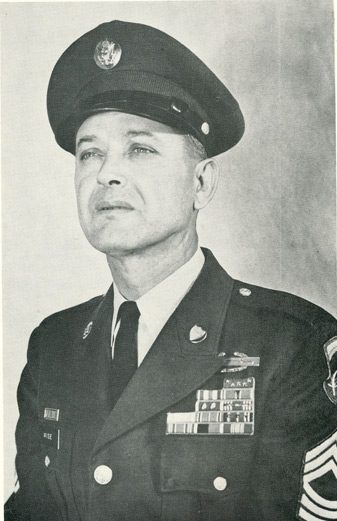
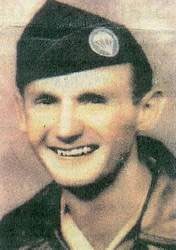
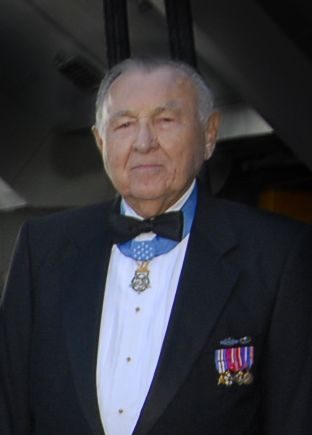
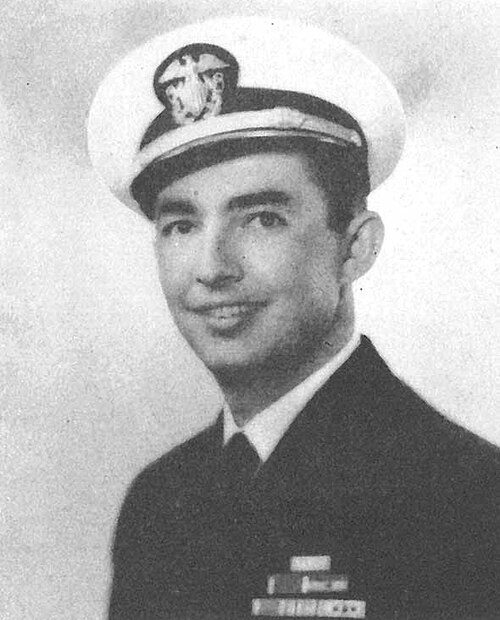
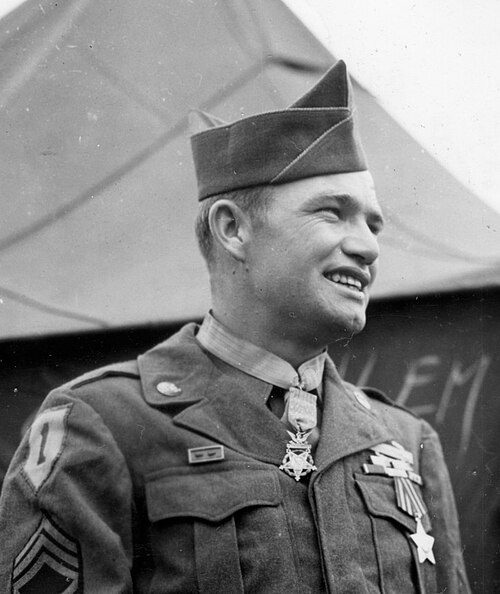
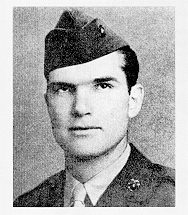
Serving as a soldier in the U.S. Army, Lieutenant Colonel Matt Louis Urban received the Medal of Honor for his actions between June 14 and September 3, 1944 in France & Belgium during World War II. At the time he was serving with Company F, 2d Battalion, 60th Infantry Regiment, 9th Infantry Division. Urban was 24 years old.
One other service member also received the Medal of Honor for actions on the same day. The medal was presented on July 19, 1980, 36 years after the action.
Urban was born on August 25, 1919 in Buffalo, Erie County, New York. His Medal of Honor is credited to Fort Bragg, Cumberland County, North Carolina. Urban died on March 4, 1995 in Holland, Michigan, at the age of 75. He is buried at Arlington National Cemetery in Arlington, Virginia. His medal is held by Michigan Heroes Museum (duplicate Medal), Frankenmuth, MI.
Urban is one of 474 Medal of Honor recipients from World War II and one of 22 credited to North Carolina.
Official Medal of Honor citation
Lt. Col. (then Capt.) Matt Urban, 112-22-2414, United States Army, who distinguished himself by a series of bold, heroic actions, exemplified by singularly outstanding combat leadership, personal bravery, and tenacious devotion to duty, during the period from 14 June to 3 September 1944 while assigned to the 2d Battalion, 60th Infantry Regiment, 9th Infantry Division. On 14 June, Capt. Urban's company, attacking at Renouf, France, encountered heavy enemy small-arms and tank fire. The enemy tanks were unmercifully raking his unit's positions and inflicting heavy casualties. Capt. Urban, realizing that his company was in imminent danger of being decimated, armed himself with a bazooka. He worked his way with an ammo carrier through hedgerows, under a continuing barrage of fire, to a point near the tanks. He brazenly exposed himself to the enemy fire and, firing the bazooka, destroyed both tanks. Responding to Capt. Urban's action, his company moved forward and routed the enemy. Later that same day, still in the attack near Orglandes, Capt. Urban was wounded in the leg by direct fire from a 37-mm tank gun. He refused evacuation and continued to lead his company until they moved into defensive positions for the night. At 0500 hours the next day, still in the attack near Orglandes, Capt. Urban, though badly wounded, directed his company in another attack. One hour later he was again wounded. Suffering from two wounds, one serious, he was evacuated to England. In mid-July, while recovering from his wounds, he learned of his unit's severe losses in the hedgerows of Normandy. Realizing his unit's need for battle-tested leaders, he voluntarily left the hospital and hitchhiked his way back to his unit near Saint-Lo, France. Arriving at the 2d Battalion Command Post at 1130 hours on 25 July, he found that his unit had jumped off at 1100 hours in the first attack of "Operation Cobra." Still limping from his leg wound, Capt. Urban made his way forward to retake command of his company. He found his company held up by strong enemy opposition. Two supporting tanks had been destroyed and another, intact but with no tank commander or gunner, was not moving. He located a lieutenant in charge of the support tanks and directed a plan of attack to eliminate the enemy strongpoint. The lieutenant and a sergeant were immediately killed by the heavy enemy fire when they tried to mount the tank. Capt. Urban, though physically hampered by his leg wound and knowing quick action had to be taken, dashed through the scathing fire and mounted the tank. With enemy bullets ricocheting from the tank, Capt. Urban ordered the tank forward and, completely exposed to the enemy fire, manned the machine gun and placed devastating fire on the enemy. His action, in the face of enemy fire, galvanized the battalion into action and they attacked and destroyed the enemy position. On 2 August, Capt. Urban was wounded in the chest by shell fragments and, disregarding the recommendation of the battalion surgeon, again refused evacuation. On 6 August, Capt. Urban became the commander of the 2d Battalion. On 15 August, he was again wounded but remained with his unit. On 3 September, the 2d Battalion was given the mission of establishing a crossing-point on the Meuse River near Heer, Belgium. The enemy planned to stop the advance of the Allied Army by concentrating heavy forces at the Meuse. The 2d Battalion, attacking toward the crossing-point, encountered fierce enemy artillery, small-arms, and mortar fire which stopped the attack. Capt. Urban quickly moved from his command post to the lead position of the battalion. Reorganizing the attacking elements, he personally led a charge toward the enemy's strongpoint. As the charge moved across the open terrain, Capt. Urban was seriously wounded in the neck. Although unable to talk above a whisper from the paralyzing neck wound, and in danger of losing his life, he refused to be evacuated until the enemy was routed and his battalion had secured the crossing-point on the Meuse River. Capt. Urban's personal leadership, limitless bravery, and repeated extraordinary exposure to enemy fire served as an inspiration to his entire battalion. His valorous and intrepid actions reflect the utmost credit upon him and uphold the noble traditions of the United States Army.
Citation text: U.S. Government, public domain.
Wounds and injuries
What the citation records about his wounds:
Later that same day, still in the attack near Orglandes, Capt. Urban was wounded in the leg by direct fire from a 37-mm tank gun.
At 0500 hours the next day, still in the attack near Orglandes, Capt. Urban, though badly wounded, directed his company in another attack.
One hour later he was again wounded.
- Age at death: 75
- Resting place: Arlington National Cemetery
Other decorations and honors
Besides the Medal of Honor, Matt Louis Urban received:
Source: Wikidata. Gold chips link to our guide to that decoration.
Battles and campaigns
Also served in: World War II.
Life beyond the battlefield
- Education: East High School, Cornell University
Source: Wikidata.
Places
Veteran resources, cemeteries and meeting places in North Carolina →
Timeline
- August 25, 1919Born in Buffalo, Erie County, New York
- June 14 - September 3, 1944Act of valor — France & BelgiumAge 24. Company F, 2d Battalion, 60th Infantry Regiment, 9th Infantry Division
- July 19, 1980Medal of Honor presented
- March 4, 1995Died in Holland, MichiganAge 75.
- Resting placeArlington National CemeteryArlington, Virginia
Biography
Matt Louis Urban (August 25, 1919 – March 4, 1995) was a United States Army lieutenant colonel and one of the most decorated American soldiers of World War II. Urban performed valiantly in combat on many occasions despite being wounded in action several times. He received over a dozen personal decorations for combat, including seven Purple Hearts. In 1980, he received the Medal of Honor and three other U.S. decorations and one foreign decoration for his actions in France and Belgium in 1944.
From the Wikipedia article “Matt Urban”, licensed under CC BY-SA 4.0. Read the full article →