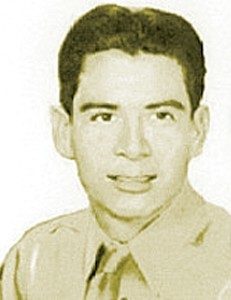
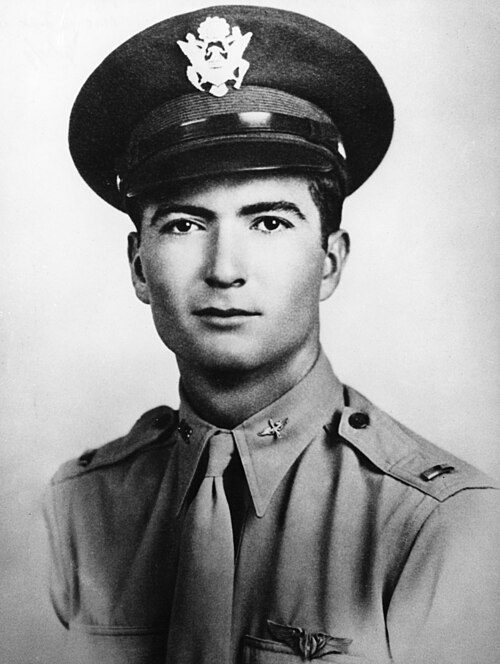
Staff Sergeant George D. Keathley was a soldier in the U.S. Army who was awarded the Medal of Honor posthumously for his actions on September 14, 1944 in Mount Altuzzo, Italy during World War II. At the time he was serving with 1st Platoon, Company B, 85th Infantry Division. Keathley was 27 years old.
Keathley was killed in the action for which his medal was awarded. 3 other service members also received the Medal of Honor for actions on the same day. The medal was presented on April 11, 1945.
Keathley was born on March 10, 1917 in Olney, Young County, Texas. His Medal of Honor is credited to Lamesa, Dawson County, Texas. He is buried at A.B.M.C. Florence Cemetery in Florence, Italy. His medal is held by Musee National de la Legion d'Honneur, Paris, France ; Sam Houston Sanders Corps of Cadets Center, Texas A&M University, College Station, TX ; Memorial Student Center, Texas A&M University (duplicate Medal), College Station, TX.
Keathley is one of 474 Medal of Honor recipients from World War II and one of 78 credited to Texas.
Official Medal of Honor citation
For conspicuous gallantry and intrepidity at the risk of his life above and beyond the call of duty, in action on the western ridge of Mount Altuzzo, Italy. After bitter fighting his company had advanced to within 50 yards of the objective, where it was held up due to intense enemy sniper, automatic, small-arms, and mortar fire. The enemy launched three desperate counterattacks in an effort to regain their former positions, but all three were repulsed with heavy casualties on both sides. All officers and noncommissioned officers of the 2d and 3d platoons of Company B had become casualties, and S/Sgt. Keathley, guide of the 1st platoon, moved up and assumed command of both the 2d and 3d platoons, reduced to 20 men. The remnants of the two platoons were dangerously low on ammunition, so S/Sgt. Keathley, under deadly small-arms and mortar fire, crawled from one casualty to another, collecting their ammunition and administering first aid. He then visited each man of his two platoons, issuing the precious ammunition he had collected from the dead and wounded, and giving them words of encouragement. The enemy now delivered their fourth counterattack, which was approximately two companies in strength. In a furious charge they attacked from the front and both flanks, throwing hand grenades, firing automatic weapons, and assisted by a terrific mortar barrage. So strong was the enemy counterattack that the company was given up for lost. The remnants of the 2d and 3d platoons of Company B were now looking to S/Sgt. Keathley for leadership. He shouted his orders precisely and with determination and the men responded with all that was in them. Time after time the enemy tried to drive a wedge into S/Sgt. Keathley's position and each time they were driven back, suffering huge casualties. Suddenly an enemy hand grenade hit and exploded near S/Sgt. Keathley, inflicting a mortal wound in his left side. However, hurling defiance at the enemy, he rose to his feet. Taking his left hand away from his wound and using it to steady his rifle, he fired and killed an attacking enemy soldier, and continued shouting orders to his men. His heroic and intrepid action so inspired his men that they fought with incomparable determination and viciousness. For 15 minutes S/Sgt. Keathley continued leading his men and effectively firing his rifle. He could have sought a sheltered spot and perhaps saved his life, but instead he elected to set an example for his men and make every possible effort to hold his position. Finally, friendly artillery fire helped to force the enemy to withdraw, leaving behind many of their number either dead or seriously wounded. S/Sgt. Keathley died a few moments later. Had it not been for his indomitable courage and incomparable heroism, the remnants of three rifle platoons of Company B might well have been annihilated by the overwhelming enemy attacking force. His actions were in keeping with the highest traditions of the military service.
Citation text: U.S. Government, public domain.
Wounds and death in action
What the citation records about his wounds:
Taking his left hand away from his wound and using it to steady his rifle, he fired and killed an attacking enemy soldier, and continued shouting orders to his men.
- Killed in action during the act for which the medal was awarded (September 14, 1944).
- Age at death: 27
- Resting place: A.B.M.C. Florence Cemetery
Other decorations and honors
Besides the Medal of Honor, George D. Keathley received:
Source: Wikidata. Gold chips link to our guide to that decoration.
Battles and campaigns
Also served in: World War II.
Life beyond the battlefield
- Education: Texas A&M University
Source: Wikidata.
Places
Timeline
- March 10, 1917Born in Olney, Young County, Texas
- September 14, 1944Act of valor — Mount Altuzzo, ItalyAge 27. 1st Platoon, Company B, 85th Infantry Division Killed in action.
- April 11, 1945Medal of Honor presented posthumously
- Resting placeA.B.M.C. Florence CemeteryFlorence
Biography
George Dennis Keathley (November 10, 1907 – September 14, 1944) was a staff sergeant in the United States Army who received the Medal of Honor for his actions during World War II.
From the Wikipedia article “George D. Keathley”, licensed under CC BY-SA 4.0. Read the full article →