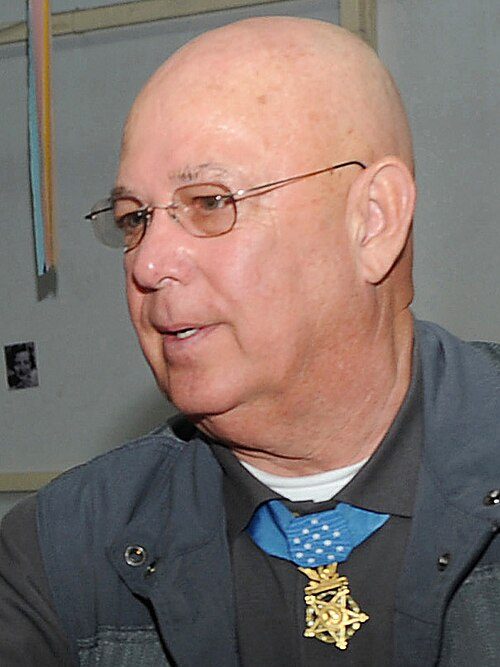
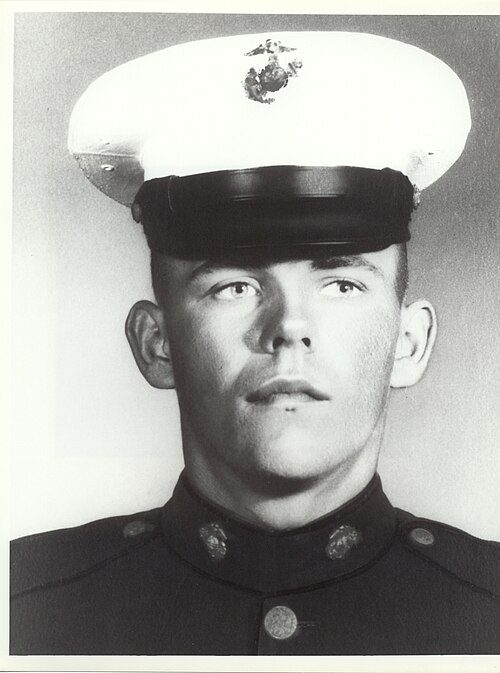
Sergeant Gary Michael Rose was a soldier in the U.S. Army who received the Medal of Honor for his actions between September 11 and 14, 1970 in Laos during the Vietnam War. At the time he was serving with Command and Control Central, Special Operations Augmentation, Command & Control Center, 5th Special Forces Group, 1st Special Forces. Rose was 22 years old.
The medal was presented on October 23, 2017, 47 years after the action — at The White House presented by President Donald J. Trump. He later rose to the rank of Captain.
Rose was born on October 17, 1947 in Watertown, Jefferson County, New York. His Medal of Honor is credited to Panorama City, Los Angeles County, California. Rose is one of the living Medal of Honor recipients.
Rose is one of 274 Medal of Honor recipients from the Vietnam War and one of 142 credited to California.
Official Medal of Honor citation
Sergeant Gary Michael Rose distinguished himself by acts of gallantry and intrepidity at the risk of his life above and beyond the call of duty while serving as a Special Forces Medic with a company sized exploitation force, 5th Special Forces Group, 1st Special Forces. Between 11 and 14 September 1970, Sergeant Rose’s company was continuously engaged by a well-armed and numerically superior hostile force deep in enemy-controlled territory. Enemy B-40 rockets and mortar rounds rained down while the adversary sprayed the area with small arms and machine gun fire, wounding many and forcing everyone to seek cover. Sergeant Rose, braving the hail of bullets, sprinted fifty meters to a wounded soldier’s side. He then used his own body to protect the casualty from further injury while treating his wounds. After stabilizing the casualty, Sergeant Rose carried him through the bullet-ridden combat zone to protective cover. As the enemy accelerated the attack, Sergeant Rose continuously exposed himself to intense fire as he fearlessly moved from casualty to casualty, administering life-saving aid. A B-40 rocket impacted just meters from Sergeant Rose, knocking him from his feet and injuring his head, hand, and foot. Ignoring his wounds, Sergeant Rose struggled to his feet and continued to render aid to the other injured soldiers. During an attempted medevac, Sergeant Rose again exposed himself to enemy fire as he attempted to hoist wounded personnel up to the hovering helicopter, which was unable to land due to unsuitable terrain. The medevac mission was aborted due to intense enemy fire and the helicopter crashed a few miles away due to the enemy fire sustained during the attempted extraction. Over the next two days, Sergeant Rose continued to expose himself to enemy fire in order to treat the wounded, estimated to be half of the company’s personnel. On September 14, during the company’s eventual helicopter extraction, the enemy launched a full-scale offensive. Sergeant Rose, after loading wounded personnel on the first set of extraction helicopters, returned to the outer perimeter under enemy fire, carrying friendly casualties and moving wounded personnel to more secure positions until they could be evacuated. He then returned to the perimeter to help repel the enemy until the final extraction helicopter arrived. As the final helicopter was loaded, the enemy began to overrun the company’s position, and the helicopter’s Marine door gunner was shot in the neck. Sergeant Rose instantly administered critical medical treatment onboard the helicopter, saving the Marine’s life. The helicopter carrying Sergeant Rose crashed several hundred meters from the evacuation point, further injuring Sergeant Rose and the personnel on board. Despite his numerous wounds from the past three days, Sergeant Rose continued to pull and carry unconscious and wounded personnel out of the burning wreckage and continued to administer aid to the wounded until another extraction helicopter arrived. Sergeant Rose’s extraordinary heroism and selflessness above and beyond the call of duty were critical to saving numerous lives over that four day time period. His actions are in keeping with the highest traditions of military service and reflect great credit upon himself, the 1st Special Forces, and the United States Army.
Citation text: U.S. Government, public domain.
Wounds and injuries
What the citation records about his wounds:
He then used his own body to protect the casualty from further injury while treating his wounds.
During an attempted medevac, Sergeant Rose again exposed himself to enemy fire as he attempted to hoist wounded personnel up to the hovering helicopter, which was unable to land due to unsuitable terrain.
The helicopter carrying Sergeant Rose crashed several hundred meters from the evacuation point, further injuring Sergeant Rose and the personnel on board.
Battles and campaigns
Also served in: Vietnam War.
Life beyond the battlefield
- Occupations: combat medic
- Education: James Monroe High School (California), Cameron University, University of Oklahoma
Source: Wikidata.
Places
- Born: Watertown — map
Veteran resources, cemeteries and meeting places in California →
Timeline
- October 17, 1947Born in Watertown, Jefferson County, New York
- September 11 - 14, 1970Act of valor — LaosAge 22. Command and Control Central, Special Operations Augmentation, Command & Control Center, 5th Special Forces Group, 1st Special Forces
- October 23, 2017Medal of Honor presentedAt The White House presented by President Donald J. Trump
Biography
Gary Michael Rose (born 17 October 1947) is a retired United States Army officer and a Vietnam War veteran. For his actions during the war, Rose was recommended for the Medal of Honor, but this was downgraded to the Distinguished Service Cross due to the classified nature of the mission in Laos. He was finally presented the Medal of Honor on 23 October 2017. After enlisting in the United States Army in 1967, Rose became a Special Forces combat medic, and in September 1970 distinguished himself in fighting in Laos at Chavane during Operation Tailwind, in which he treated the wounded while fighting People's Army of Vietnam (PAVN) forces.
From the Wikipedia article “Gary M. Rose”, licensed under CC BY-SA 4.0. Read the full article →
Videos
Videos load from Vimeo only after you press play.
Further reading
- Why Medal of Honor Recipients are Not Called Winnerscmohs.org · 2024
- 4 days in September: Alabama Medal of Honor recipient recounts time in Vietnamal.com · 2021
- Medal of Honor recipient to speak in Huntsville on birthday of U.S. Armythemadisonrecord.com · 2021
- Gary M. Rose, Special Forces Medic, Earned the Medal of Honor by Saving 60 Lives in Vietnammilitary.com · 2021