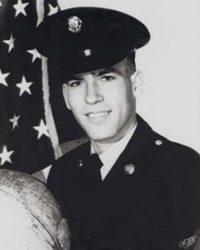
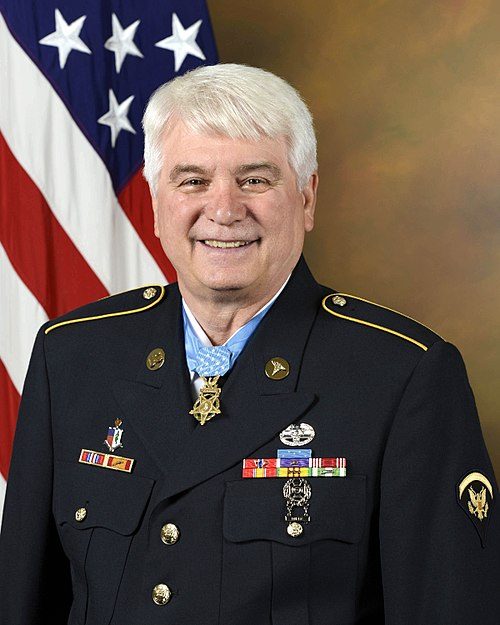
Major Charles S. Kettles, a soldier in the U.S. Army, received the Medal of Honor for gallantry on May 15, 1967 in Duc Pho, Vietnam during the Vietnam War. At the time he was serving with 176th Aviation Company, (Airmobile) (Light), 14th Combat Aviation Battalion, Americal Division. Kettles was 37 years old.
The medal was presented on July 18, 2016, 49 years after the action — presented by President Barack Obama at the White House.
Kettles was born on January 9, 1930 in Ypsilanti, Washtenaw County, Michigan. His Medal of Honor is credited to Michigan. Kettles died on January 21, 2019 in Ypsilanti, Michigan, at the age of 89. He is buried at Highland Cemetery in Ypsilanti, Michigan.
Kettles is one of 274 Medal of Honor recipients from the Vietnam War and one of 112 credited to Michigan.
Official Medal of Honor citation
Major Charles S. Kettles distinguished himself by conspicuous gallantry and intrepidity while serving as Flight Commander, 176th Aviation Company (Airmobile) (Light}, 14th Combat Aviation Battalion, Americal Division near Duc Pho, Republic of Vietnam. On 15 May 1967, Major Kettles, upon learning that an airborne infantry unit had suffered casualties during an intense firefight with the enemy, immediately volunteered to lead a flight of six UH-1D helicopters to carry reinforcements to the embattled force and to evacuate wounded personnel. Enemy small arms, automatic weapons, and mortar fire raked the landing zone, inflicting heavy damage to the helicopters; however, Major Kettles refused to depart until all helicopters were loaded to capacity. He then returned to the battlefield, with full knowledge of the intense enemy fire awaiting his arrival, to bring more reinforcements, landing in the midst of enemy mortar and automatic weapons fire that seriously wounded his gunner and severely damaged his aircraft. Upon departing, Major Kettles was advised by another helicopter crew that he had fuel streaming out of his aircraft. Despite the risk posed by the leaking fuel, he nursed the damaged aircraft back to base. Later that day, the Infantry Battalion Commander requested immediate, emergency extraction of the remaining 40 troops, including four members of Major Kettles' unit who were stranded when their helicopter was destroyed by enemy fire. With only one flyable UH-1 helicopter remaining, Major Kettles volunteered to return to the deadly landing zone for a third time, leading a flight of six evacuation helicopters, five of which were from the 161st Aviation Company. During the extraction, Major Kettles was informed by the last helicopter that all personnel were onboard, and departed the landing zone accordingly. Army gunships supporting the evacuation also departed the area. Once airborne, Major Kettles was advised that eight troops had been unable to reach the evacuation helicopters due to the intense enemy fire. With complete disregard for his own safety, Major Kettles passed the lead to another helicopter and returned to the landing zone to rescue the remaining troops. Without gunship, artillery, or tactical aircraft support, the enemy concentrated all firepower on his lone aircraft, which was immediately damaged by a mortar round that shattered both front windshields and the chin bubble and was further raked by small arms and machine gun fire. Despite the intense enemy fire, Major Kettles maintained control of the aircraft and situation, allowing time for the remaining eight soldiers to board the aircraft. In spite of the severe damage to his helicopter, Major Kettles once more skillfully guided his heavily damaged aircraft to safety. Without his courageous actions and superior flying skills, the last group of soldiers and his crew would never have made it off the battlefield. Major Kettles' selfless acts of repeated valor and determination are in keeping with the highest traditions of military service and reflect great credit upon himself and the United States Army.
Citation text: U.S. Government, public domain.
Other decorations and honors
Besides the Medal of Honor, Charles S. Kettles received:
Source: Wikidata. Gold chips link to our guide to that decoration.
Battles and campaigns
Also served in: Korean War, Vietnam War.
Life beyond the battlefield
Source: Wikidata.
Places
Veteran resources, cemeteries and meeting places in Michigan →
Timeline
- January 9, 1930Born in Ypsilanti, Washtenaw County, Michigan
- May 15, 1967Act of valor — Duc Pho, VietnamAge 37. 176th Aviation Company, (Airmobile) (Light), 14th Combat Aviation Battalion, Americal Division
- July 18, 2016Medal of Honor presentedPresented by President Barack Obama at the White House
- January 21, 2019Died in Ypsilanti, MichiganAge 89.
- Resting placeHighland CemeteryYpsilanti, Michigan
Biography
Charles Seymour Kettles (January 9, 1930 – January 21, 2019) was a United States Army lieutenant colonel and a Medal of Honor recipient.
From the Wikipedia article “Charles Kettles”, licensed under CC BY-SA 4.0. Read the full article →
Named in his honor
- Ann Arbor VA Medical Center — Veterans Administration hospital, medical organization