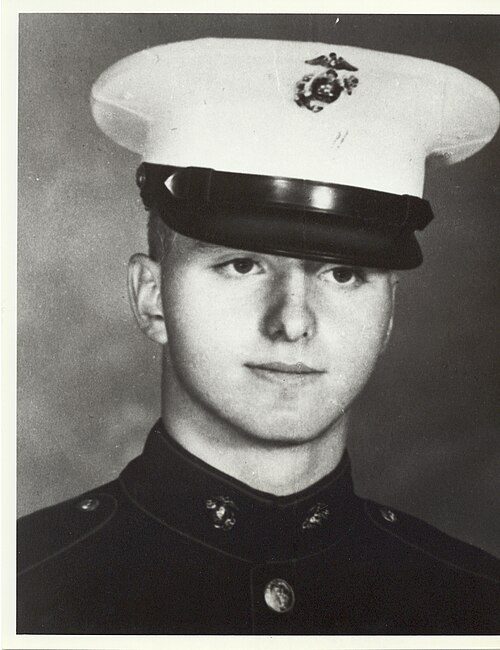
Serving as a soldier in the U.S. Army, Corporal Thomas William Bennett was awarded the Medal of Honor posthumously for his actions between February 9 and 11, 1969 in Chu Pa Region, Pleiku Province, Republic of Vietnam during the Vietnam War. At the time he was serving with 2d Platoon, Company B, 1st Battalion, 14th Infantry, 4th Infantry Division. Bennett was 21 years old.
Bennett was killed in the action for which his medal was awarded. One other service member also received the Medal of Honor for actions on the same day. The medal was presented on April 7, 1970.
Bennett was born on April 7, 1947 in Morgantown, Monongalia County, West Virginia. His Medal of Honor is credited to Fairmont, Marion County, West Virginia. He is buried at East Oak Grove Cemetery in Morgantown, West Virginia. His medal is held by West Virginia University, Morgantown, WV.
Bennett is one of 274 Medal of Honor recipients from the Vietnam War and one of 45 credited to West Virginia.
Official Medal of Honor citation
For conspicuous gallantry and intrepidity in action at the risk of his life above and beyond the call of duty. Cpl. Bennett distinguished himself while serving as a platoon medical aidman with the 2d Platoon, Company B, during a reconnaissance-in-force mission. On 9 February the platoon was moving to assist the 1st Platoon of Company D, which had run into a North Vietnamese ambush, when it became heavily engaged by the intense small-arms, automatic-weapons, mortar and rocket fire from a well-fortified and numerically superior enemy unit. In the initial barrage of fire, three of the point members of the platoon fell wounded. Cpl. Bennett, with complete disregard for his safety, ran through the heavy fire to his fallen comrades, administered life-saving first aid under fire, and then made repeated trips carrying the wounded men to positions of relative safety from which they would be medically evacuated from the battle position. Cpl. Bennett repeatedly braved the intense enemy fire, moving across open areas to give aid and comfort to his wounded comrades. He valiantly exposed himself to the heavy fire in order to retrieve the bodies of several fallen personnel. Throughout the night and following day, Cpl. Bennett moved from position to position treating and comforting several personnel who had suffered shrapnel and gunshot wounds. On 11 February, Company B again moved in an assault on the well-fortified enemy positions and became heavily engaged with the numerically superior enemy force. Five members of the company fell wounded in the initial assault. Cpl. Bennett ran to their aid without regard to the heavy fire. He treated one wounded comrade and began running toward another seriously wounded man. Although the wounded man was located forward of the company position covered by heavy enemy grazing fire and Cpl. Bennett was warned that it was impossible to reach the position, he leaped forward with complete disregard for his safety to save his comrade's life. In an attempt to save his fellow soldier, he was mortally wounded. Cpl. Bennett's undaunted concern for his comrades at the cost of his life above and beyond the call of duty are in keeping with the highest traditions of the military service and reflect great credit upon himself, his unit, and the U.S. Army.
Citation text: U.S. Government, public domain.
Wounds and death in action
What the citation records about his wounds:
Throughout the night and following day, Cpl. Bennett moved from position to position treating and comforting several personnel who had suffered shrapnel and gunshot wounds.
He treated one wounded comrade and began running toward another seriously wounded man.
Although the wounded man was located forward of the company position covered by heavy enemy grazing fire and Cpl. Bennett was warned that it was impossible to reach the position, he leaped forward with complete disregard for his safety to save his comrade's life.
- Killed in action during the act for which the medal was awarded (February 11, 1969).
- Age at death: 21
- Resting place: East Oak Grove Cemetery
Other decorations and honors
Besides the Medal of Honor, Thomas William Bennett received:
Source: Wikidata. Gold chips link to our guide to that decoration.
Battles and campaigns
Also served in: Vietnam War.
Life beyond the battlefield
- Education: Morgantown High School
Source: Wikidata.
Places
Veteran resources, cemeteries and meeting places in West Virginia →
Timeline
- April 7, 1947Born in Morgantown, Monongalia County, West Virginia
- February 9 - 11, 1969Act of valor — Chu Pa Region, Pleiku Province, Republic of VietnamAge 21. 2d Platoon, Company B, 1st Battalion, 14th Infantry, 4th Infantry Division Killed in action.
- April 7, 1970Medal of Honor presented posthumously
- Resting placeEast Oak Grove CemeteryMorgantown, West Virginia
Biography
Thomas William Bennett (April 7, 1947 – February 11, 1969) was a United States Army medic who was killed in action during the Vietnam War and the second conscientious objector to receive the Medal of Honor. Bennett received the medal after repeatedly putting himself in harm's way to save wounded soldiers during operations in the Central Highlands of Vietnam. He was mortally wounded during one of these actions in Pleiku Province and received the Medal of Honor posthumously.
From the Wikipedia article “Thomas W. Bennett (conscientious objector)”, licensed under CC BY-SA 4.0. Read the full article →