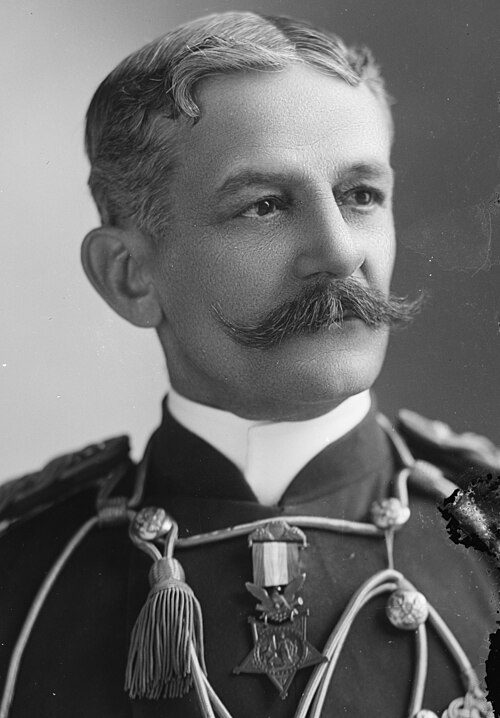
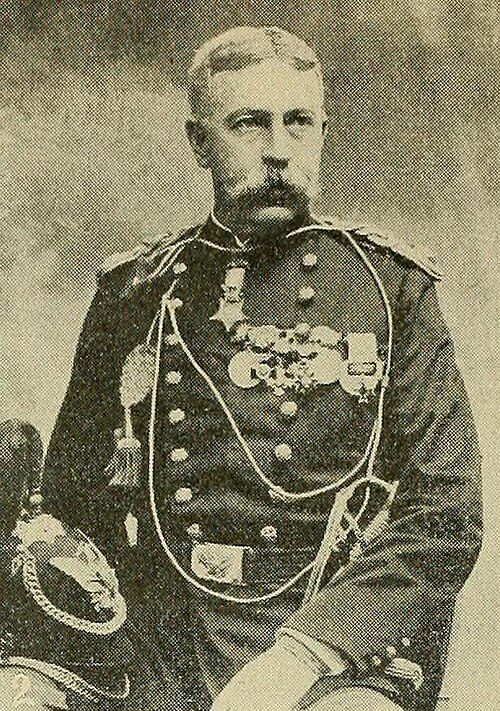
Second Lieutenant Robert Lee Howze was a soldier in the U.S. Army who received the Medal of Honor for his actions on January 1, 1891 at White River, South Dakota during the Indian Campaigns. At the time he was serving with Company K, 6th U.S. Cavalry. Howze was 26 years old.
5 other service members also received the Medal of Honor for actions on the same day. The medal was presented on July 25, 1891. He later rose to the rank of Major General.
Howze was born on August 22, 1864 in Overton, Rusk County, Texas. Howze died on September 19, 1926 in Columbus, Ohio, at the age of 62. He is buried at U.S. Military Academy Cemetery in West Point, New York.
Howze is one of 426 Medal of Honor recipients from the Indian Campaigns and one of 78 credited to Texas.
Official Medal of Honor citation
Bravery in action.
Citation text: U.S. Government, public domain.
Other decorations and honors
Besides the Medal of Honor, Robert Lee Howze received:
Source: Wikidata. Gold chips link to our guide to that decoration.
Battles and campaigns
Also served in: World War I, Spanish–American War.
Life beyond the battlefield
- Education: United States Military Academy
Source: Wikidata.
Places
Timeline
- August 22, 1864Born in Overton, Rusk County, Texas
- January 1, 1891Act of valor — White River, South DakotaAge 26. Company K, 6th U.S. Cavalry
- July 25, 1891Medal of Honor presented
- September 19, 1926Died in Columbus, OhioAge 62.
- Resting placeU.S. Military Academy CemeteryWest Point, New York
Biography
Robert Lee Howze (August 22, 1864 – September 19, 1926) was a United States Army major general who was a recipient of the Medal of Honor for his actions during the American Indian Wars. Howze graduated from the United States Military Academy in 1888 and then accepted a commission to the United States Army. He first served in the Indian Wars, then served in the Spanish–American War, Philippine–American War and World War I. His last assignment was presiding over the courts-martial of Colonel Billy Mitchell.
From the Wikipedia article “Robert Lee Howze”, licensed under CC BY-SA 4.0. Read the full article →