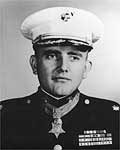
Second Lieutenant Raymond Gerald Murphy, a Marine in the U.S. Marine Corps, received the Medal of Honor for gallantry on February 3, 1953 at Ungok Hill, west of Panmunjan, Korea during the Korean War. At the time he was serving with 1st Platoon, Company A, 1st Battalion, 5th Marines, 1st Marine Division (Rein). Murphy was 23 years old.
The medal was presented on October 27, 1953 — the White House, presented by Pres. Dwight D. Eisenhower. He later rose to the rank of Captain.
Murphy was born on January 14, 1930 in Pueblo, Pueblo County, Colorado. Murphy died on April 6, 2007 in Pueblo, Colorado, at the age of 77. He is buried at Sante Fe National Cemetery in Sante Fe, New Mexico.
Murphy is one of 153 Medal of Honor recipients from the Korean War and one of 24 credited to Colorado.
Official Medal of Honor citation
For conspicuous gallantry and intrepidity at the risk of his life above and beyond the call of duty as a platoon commander of Company A, in action against enemy aggressor forces. Although painfully wounded by fragments from an enemy mortar shell while leading his evacuation platoon in a support of assault units attacking a cleverly concealed and well-entrenched hostile force occupying commanding ground, 2d Lt. Murphy steadfastly refused medical aid and continued to lead his men up a hill through a withering barrage of hostile mortar and small-arms fire, skillfully maneuvering his force from one position to the next and shouting words of encouragement. Undeterred by the increasing intense enemy fire, he immediately located casualties as they fell and made several trips up and down the fire-swept hill to direct evacuation teams to the wounded, personally carrying many of the stricken marines to safety. When reinforcements were needed by the assaulting elements, 2d Lt. Murphy employed part of his unit as support and, during the ensuing battle, personally killed two of the enemy with his pistol. With all the wounded evacuated and the assaulting units beginning to disengage, he remained behind with a carbine to cover the movement of friendly forces off the hill and, though suffering intense pain from his previous wounds, seized an automatic rifle to provide more firepower when the enemy reappeared in the trenches. After reaching the base of the hill, he organized a search party and again ascended the slope for a final check on missing marines, locating and carrying the bodies of a machine-gun crew back down the hill. Wounded a second time while conducting the entire force to the line of departure through a continuing barrage of enemy small-arms, artillery, and mortar fire, he again refused medical assistance until assured that every one of his men, including all casualties, had preceded him to the main lines. His resolute and inspiring leadership, exceptional fortitude, and great personal valor reflect the highest credit upon 2d Lt. Murphy and enhance the finest traditions of the U.S. Naval Service.
Citation text: U.S. Government, public domain.
Wounds and injuries
What the citation records about his wounds:
Although painfully wounded by fragments from an enemy mortar shell while leading his evacuation platoon in a support of assault units attacking a cleverly concealed and well-entrenched hostile force occupying commanding ground, 2d Lt. Murphy steadfastly refused medical aid and continued to lead his men up a hill through a withering barrage of hostile mortar and small-arms fire, skillfully maneuvering his force from one position to the next and shouting words of encouragement.
With all the wounded evacuated and the assaulting units beginning to disengage, he remained behind with a carbine to cover the movement of friendly forces off the hill and, though suffering intense pain from his previous wounds, seized an automatic rifle to provide more firepower when the enemy reappeared in the trenches.
- Age at death: 77
- Resting place: Sante Fe National Cemetery
Other decorations and honors
Besides the Medal of Honor, Raymond Gerald Murphy received:
Source: Wikidata. Gold chips link to our guide to that decoration.
Battles and campaigns
Also served in: Korean War.
Life beyond the battlefield
- Education: Adams State University
Source: Wikidata.
Places
Veteran resources, cemeteries and meeting places in Colorado →
Timeline
- January 14, 1930Born in Pueblo, Pueblo County, Colorado
- February 3, 1953Act of valor — Ungok Hill, west of Panmunjan, KoreaAge 23. 1st Platoon, Company A, 1st Battalion, 5th Marines, 1st Marine Division (Rein)
- October 27, 1953Medal of Honor presentedThe White House, presented by Pres. Dwight D. Eisenhower
- April 6, 2007Died in Pueblo, ColoradoAge 77.
- Resting placeSante Fe National CemeterySante Fe, New Mexico
Biography
Captain Raymond Gerald "Jerry" Murphy (January 14, 1930 – April 6, 2007) was the 39th United States Marine to receive the Medal of Honor for heroism in the Korean War. He was decorated by President Dwight D. Eisenhower in a White House ceremony on October 27, 1953. He earned the Nation's highest military decoration for heroic action for valor in the Reno-Vegas fighting of February 1953.
From the Wikipedia article “Raymond G. Murphy”, licensed under CC BY-SA 4.0. Read the full article →
Videos
Videos load from Vimeo only after you press play.