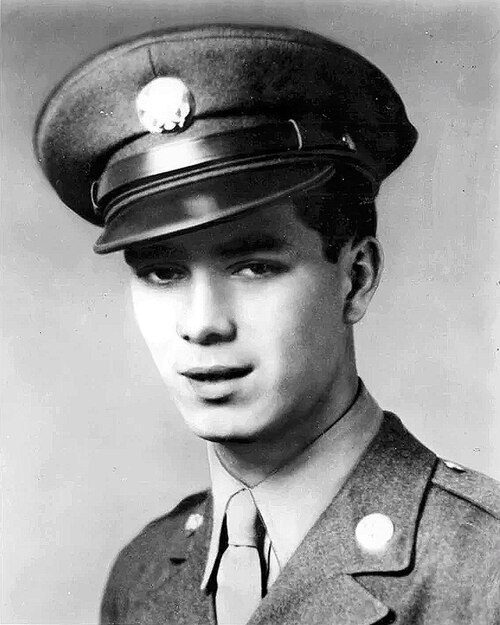
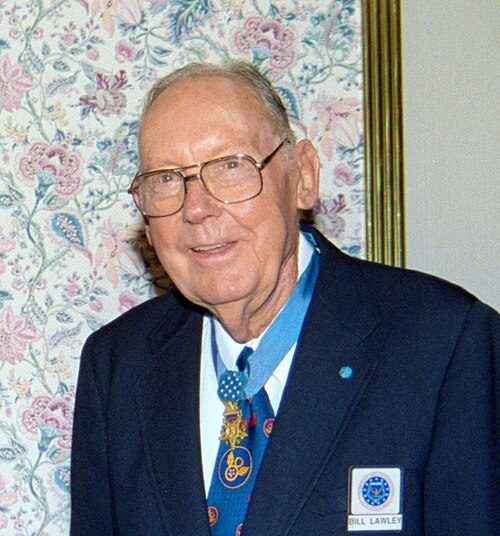
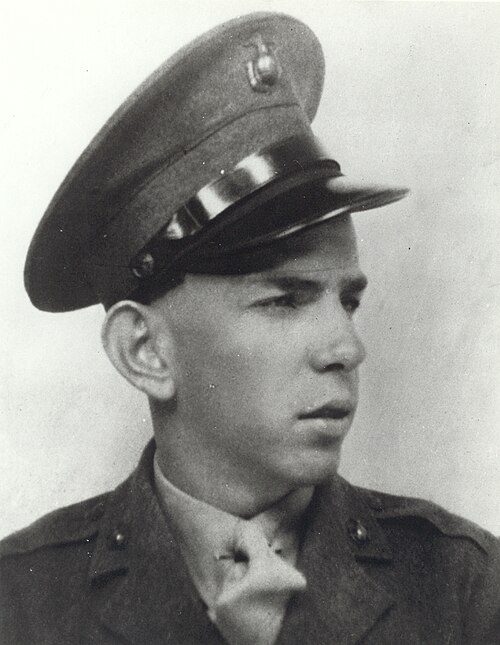
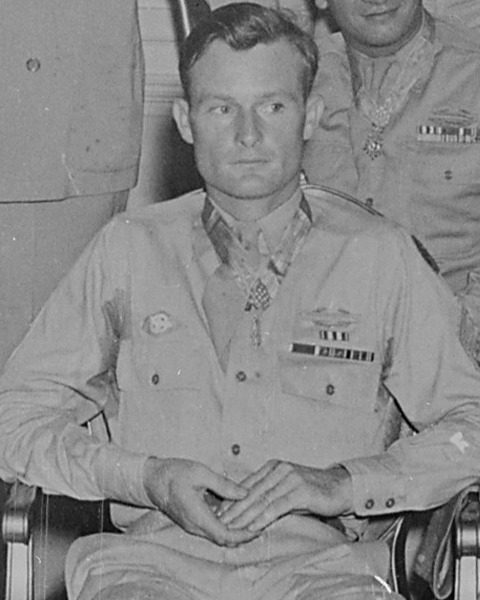
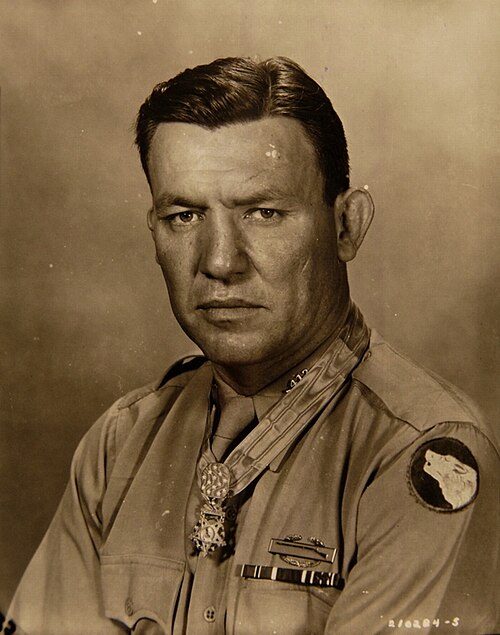
Staff Sergeant Henry Eugene "red" Erwin, an airman in the U.S. Army Air Corps, received the Medal of Honor for gallantry on April 12, 1945 in Koriyama, Japan during World War II. At the time he was serving with 52d Bombardment Squadron, 29th Bombardment Group, 314th Bombardment Wing, 20th Air Force. Erwin was 23 years old.
One other service member also received the Medal of Honor for actions on the same day. The medal was presented on April 19, 1945. Fleet Hospital 103, Guam, presented by Gen. Curtis LeMay. He later rose to the rank of Master Sergeant.
Erwin was born on May 8, 1921 in Adamsville, Jefferson County, Alabama. His Medal of Honor is credited to Bessemer, Jefferson County, Alabama. Erwin died on January 16, 2002 in Leeds, Alabama, at the age of 80. He is buried at Elmwood Cemetery in Birmingham, Alabama.
Erwin is one of 474 Medal of Honor recipients from World War II and one of 21 credited to Alabama.
Official Medal of Honor citation
He was the radio operator of a B-29 airplane leading a group formation to attack Koriyama, Japan. He was charged with the additional duty of dropping phosphorus smoke bombs to aid in assembling the group when the launching point was reached. Upon entering the assembly area, aircraft fire and enemy fighter opposition was encountered. Among the phosphorus bombs launched by S/Sgt. Erwin, one proved faulty, exploding in the launching chute, and shot back into the interior of the aircraft, striking him in the face. The burning phosphorus obliterated his nose and completely blinded him. Smoke filled the plane, obscuring the vision of the pilot. S/Sgt. Erwin realized that the aircraft and crew would be lost if the burning bomb remained in the plane. Without regard for his own safety, he picked it up and feeling his way, instinctively, crawled around the gun turret and headed for the copilot's window. He found the navigator's table obstructing his passage. Grasping the burning bomb between his forearm and body, he unleashed the spring lock and raised the table. Struggling through the narrow passage he stumbled forward into the smoke-filled pilot's compartment. Groping with his burning hands, he located the window and threw the bomb out. Completely aflame, he fell back upon the floor. The smoke cleared, the pilot, at 300 feet, pulled the plane out of its dive. S/Sgt. Erwin's gallantry and heroism above and beyond the call of duty saved the lives of his comrades.
Citation text: U.S. Government, public domain.
Other decorations and honors
Besides the Medal of Honor, Henry Eugene "red" Erwin received:
Source: Wikidata. Gold chips link to our guide to that decoration.
Battles and campaigns
Also served in: World War II.
Life beyond the battlefield
- Occupations: radio operator
Source: Wikidata.
Places
Veteran resources, cemeteries and meeting places in Alabama →
Timeline
- May 8, 1921Born in Adamsville, Jefferson County, Alabama
- April 12, 1945Act of valor — Koriyama, JapanAge 23. 52d Bombardment Squadron, 29th Bombardment Group, 314th Bombardment Wing, 20th Air Force
- April 19, 1945Medal of Honor presentedFleet Hospital 103, Guam, presented by Gen. Curtis LeMay
- January 16, 2002Died in Leeds, AlabamaAge 80.
- Resting placeElmwood CemeteryBirmingham, Alabama
Biography
Henry Eugene Erwin Sr. (May 8, 1921 – January 16, 2002) was a United States Army Air Forces airman and a recipient of the U.S. military's highest decoration—the Medal of Honor—for his actions in World War II. He earned the award as a staff sergeant and radio operator aboard a B-29 Superfortress in the Asia-Pacific theater. During a 1945 bombing mission over Koriyama, Japan, a white phosphorus bomb prematurely ignited in his aircraft and seriously wounded him. As smoke filled the plane, he picked up the burning device and carried it through the aircraft to the cockpit where he tossed it out a window.
From the Wikipedia article “Henry E. Erwin”, licensed under CC BY-SA 4.0. Read the full article →
Videos
Videos load from Vimeo only after you press play.