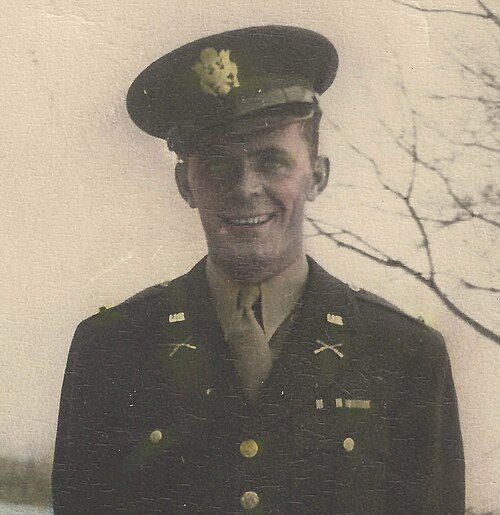
First Lieutenant Bernard James Ray was a soldier in the U.S. Army who was awarded the Medal of Honor posthumously for his actions on November 17, 1944 in Hurtgen Forest, near Schevenhutte, Germany during World War II. At the time he was serving with Company F, 8th Infantry, 4th Infantry Division. Ray was 23 years old.
Ray was killed in the action for which his medal was awarded.
Ray was born on June 9, 1921 in Brooklyn, Kings County, New York. His Medal of Honor is credited to Baldwin, Nassau County, New York. He is buried at Long Island National Cemetery in Farmingdale, New York.
Ray is one of 474 Medal of Honor recipients from World War II and one of 678 credited to New York.
Official Medal of Honor citation
He was platoon leader with Company F, 8th Infantry, on 17 November 1944, during the drive through the Hurtgen Forest near Schevenhutte, Germany. The American forces attacked in wet, bitterly cold weather over rough, wooded terrain, meeting brutal resistance from positions spaced throughout the forest behind minefields and wire obstacles. Small arms, machine-gun, mortar, and artillery fire caused heavy casualties in the ranks when Company F was halted by a concertina-type wire barrier. Under heavy fire, 1st Lt. Ray reorganized his men and prepared to blow a path through the entanglement, a task which appeared impossible of accomplishment and from which others tried to dissuade him. With impacable determination to clear the way, he placed explosive caps in his pockets, obtained several bangalore torpedoes, and then wrapped a length of highly explosive primer cord about his body. He dashed forward under direct fire, reached the barbed wire and prepared his demolition charge as mortar shells, which were being aimed at him alone, came steadily nearer his completely exposed position. He had placed a torpedo under the wire and was connecting it to a charge he carried when he was severely wounded by a bursting mortar shell. Apparently realizing that he would fail in his self-imposed mission unless he completed it in a few moments, he made a supremely gallant decision. With the primer cord still wound around his body and the explosive caps in his pocket, he completed a hasty wiring system and unhesitatingly thrust down on the handle of the charger, destroying himself with the wire barricade in the resulting blast. By the deliberate sacrifice of his life, 1st Lt. Ray enabled his company to continue its attack, the resumption of which was of positive significance in gaining the approaches to the Cologne Plain.
Citation text: U.S. Government, public domain.
Wounds and death in action
What the citation records about his wounds:
He had placed a torpedo under the wire and was connecting it to a charge he carried when he was severely wounded by a bursting mortar shell.
- Killed in action during the act for which the medal was awarded (November 17, 1944).
- Age at death: 23
- Resting place: Long Island National Cemetery
Other decorations and honors
Besides the Medal of Honor, Bernard James Ray received:
Source: Wikidata. Gold chips link to our guide to that decoration.
Battles and campaigns
Also served in: World War II.
Life beyond the battlefield
- Education: Baldwin Senior High School
Source: Wikidata.
Places
Veteran resources, cemeteries and meeting places in New York →
Timeline
- June 9, 1921Born in Brooklyn, Kings County, New York
- November 17, 1944Act of valor — Hurtgen Forest, near Schevenhutte, GermanyAge 23. Company F, 8th Infantry, 4th Infantry Division Killed in action.
- Resting placeLong Island National CemeteryFarmingdale, New York
Biography
Bernard James Ray (June 9, 1921 – November 17, 1944) was a United States Army officer and a recipient of the United States military's highest decoration—the Medal of Honor—for his actions in World War II during the Battle of Hurtgen Forest.
From the Wikipedia article “Bernard J. Ray”, licensed under CC BY-SA 4.0. Read the full article →