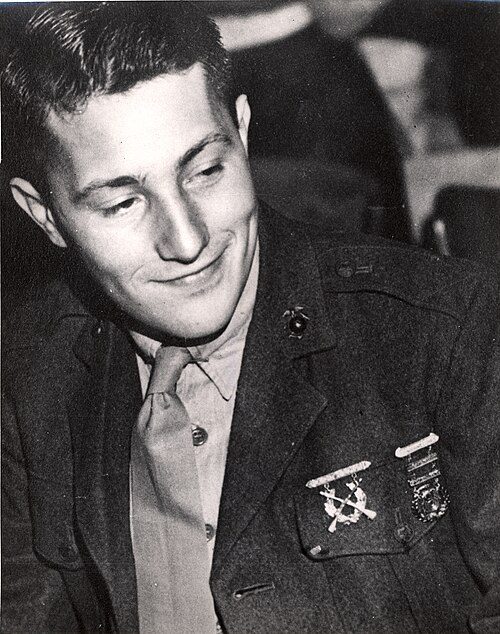
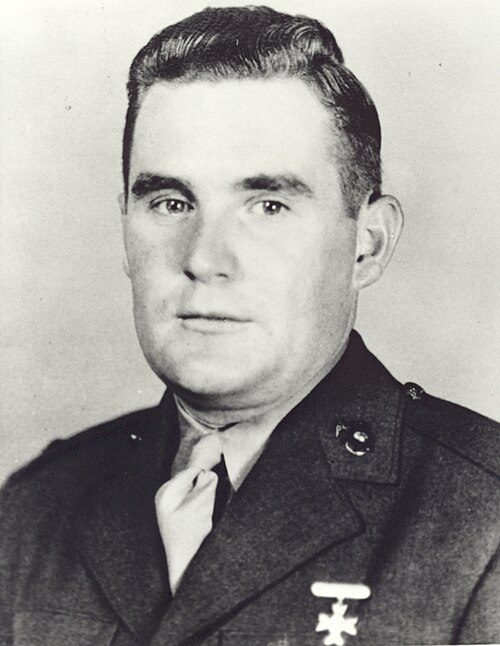
Serving as a soldier in the U.S. Army, Private First Class Alton W. Knappenberger received the Medal of Honor for his actions on February 1, 1944 near Cisterna di Littoria, Italy during World War II. At the time he was serving with 1st Platoon, Company C, 15th Battalion, 30th Infantry, 3d Infantry Division. Knappenberger was 20 years old.
4 other service members also received the Medal of Honor for actions on the same day. The medal was presented on June 8, 1944. Rome, Italy, presented by Lt. Gen. Mark W. Clark. He later rose to the rank of Staff Sergeant.
Knappenberger was born on December 31, 1923 in Coopersburg, Lehigh County, Pennsylvania. His Medal of Honor is credited to Almount, Bucks County, Pennsylvania. Knappenberger died on June 9, 2008 in Pottstown, Pennsylvania, at the age of 84. He is buried at Arlington National Cemetery in Arlington, Virginia.
Knappenberger is one of 474 Medal of Honor recipients from World War II and one of 380 credited to Pennsylvania.
Official Medal of Honor citation
For conspicuous gallantry and intrepidity at the risk of his life above and beyond the call of duty in action involving actual conflict with the enemy, on 1 February 1944 near Cisterna di Littoria, Italy. When a heavy German counterattack was launched against his battalion, Pfc. Knappenberger crawled to an exposed knoll and went into position with his automatic rifle. An enemy machine gun 85 yards away opened fire, and bullets struck within six inches of him. Raising to a kneeling position, Pfc. Knappenberger opened fire on the hostile crew, knocked out the gun, killed two members of the crew, and wounded the third. While he fired at this hostile position, two Germans crawled to a point within 20 yards of the knoll and threw potato-masher grenades at him, but Pfc. Knappenberger killed them both with one burst from his automatic rifle. Later, a second machine gun opened fire upon his exposed position from a distance of 100 yards, and this weapon was also silenced by his well-aimed shots. Shortly thereafter, an enemy 20-mm antiaircraft gun directed fire at him, and again Pfc. Knappenberger returned fire to wound one member of the hostile crew. Under tank and artillery shellfire, with shells bursting within 15 yards of him, he held his precarious position and fired at all enemy infantrymen armed with machine pistols and machine guns which he could locate. When his ammunition supply became exhausted, he crawled 15 yards forward through steady machine-gun fire, removed rifle clips from the belt of a casualty, returned to his position, and resumed firing to repel an assaulting German platoon armed with automatic weapons. Finally, his ammunition supply being completely exhausted, he rejoined his company. Pfc. Knappenberger's intrepid action disrupted the enemy attack for over two hours.
Citation text: U.S. Government, public domain.
Battles and campaigns
Also served in: World War II, Battle of Cisterna.
Places
Veteran resources, cemeteries and meeting places in Pennsylvania →
Timeline
- December 31, 1923Born in Coopersburg, Lehigh County, Pennsylvania
- February 1, 1944Act of valor — near Cisterna di Littoria, ItalyAge 20. 1st Platoon, Company C, 15th Battalion, 30th Infantry, 3d Infantry Division
- June 8, 1944Medal of Honor presentedRome, Italy, presented by Lt. Gen. Mark W. Clark
- June 9, 2008Died in Pottstown, PennsylvaniaAge 84.
- Resting placeArlington National CemeteryArlington, Virginia
Biography
Alton Warren Knappenberger (December 31, 1923 – June 9, 2008) was a United States Army soldier and a recipient of the United States military's highest decoration—the Medal of Honor—for his actions in World War II. Knappenberger joined the Army from Spring Mount, Pennsylvania, in March 1943, and by February 1, 1944, was serving as a private first class in the 30th Infantry Regiment, 3rd Infantry Division. On that day, during the Battle of Cisterna in Italy, Knappenberger held an exposed position alone and harassed the attacking Germans with his automatic rifle until he ran out of ammunition.
From the Wikipedia article “Alton W. Knappenberger”, licensed under CC BY-SA 4.0. Read the full article →