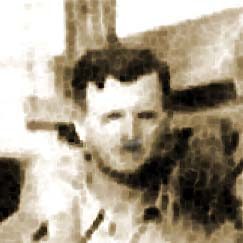
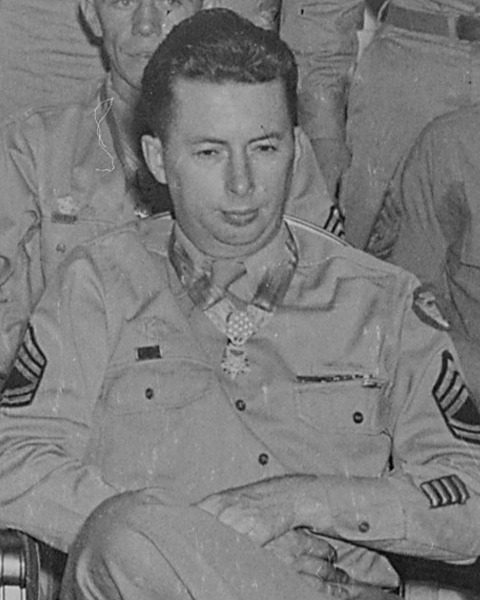
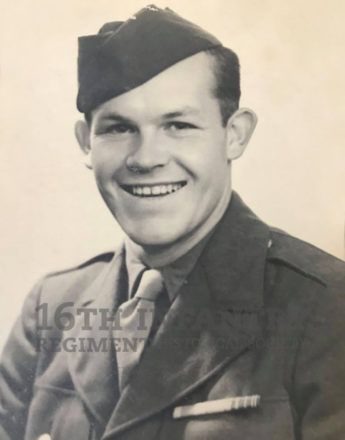
Lieutenant Colonel William Joseph O'Brien, a soldier in the U.S. Army, was awarded the Medal of Honor posthumously for gallantry between June 20 and July 7, 1944 in Saipan, Marianas Islands during World War II. At the time he was serving with 1st Battalion, 105th Infantry, 27th Infantry Division. O'Brien was about 45 years old.
O'Brien was killed in the action for which his medal was awarded.
O'Brien was born in 1899 in Troy, Rensselaer County, New York. He is buried at St. Peter's Cemetery in Troy, New York.
O'Brien is one of 474 Medal of Honor recipients from World War II and one of 678 credited to New York.
Official Medal of Honor citation
For conspicuous gallantry and intrepidity at the risk of his life above and beyond the call of duty at Saipan, Marianas Islands, from 20 June through 7 July 1944. When assault elements of his platoon were held up by intense enemy fire, Lt. Col. O'Brien ordered three tanks to precede the assault companies in an attempt to knock out the strongpoint. Due to direct enemy fire the tanks' turrets were closed, causing the tanks to lose direction and to fire into our own troops. Lt. Col. O'Brien, with complete disregard for his own safety, dashed into full view of the enemy and ran to the leader's tank and pounded on the tank with his pistol butt to attract two of the tank's crew and, mounting the tank fully exposed to the enemy fire, Lt. Col. O'Brien personally directed the assault until the enemy strongpoint had been liquidated. On 28 June 1944, while his platoon was attempting to take a bitterly defended high ridge in the vicinity of Donnay, Lt. Col. O'Brien arranged to capture the ridge by a double envelopment movement of two large combat battalions. He personally took control of the maneuver. Lt. Col. O'Brien crossed 1,200 yards of sniper- infested underbrush alone to arrive at a point where one of his platoons was being held up by the enemy. Leaving some men to contain the enemy, he personally led four men into a narrow ravine behind, and killed or drove off all the Japanese manning that strongpoint. In this action he captured five machine guns and one 77-mm fieldpiece. Lt. Col. O'Brien then organized the two platoons for night defense and against repeated counterattacks directed them. Meanwhile he managed to hold ground. On 7 July 1944 his battalion and another battalion were attacked by an overwhelming enemy force estimated at between 3,000 and 5,000 Japanese. With bloody hand-to-hand fighting in progress everywhere, their forward positions were finally overrun by the sheer weight of the enemy numbers. With many casualties and ammunition running low, Lt. Col. O'Brien refused to leave the front lines. Striding up and down the lines, he fired at the enemy with a pistol in each hand and his presence there bolstered the spirits of the men, encouraged them in their fight, and sustained them in their heroic stand. Even after he was seriously wounded, Lt. Col. O'Brien refused to be evacuated and after his pistol ammunition was exhausted, he manned a.50-caliber machine gun, mounted on a jeep, and continued firing. When last seen alive he was standing upright firing into the Jap hordes that were enveloping him. Some time later his body was found surrounded by enemy he had killed. His valor was consistent with the highest traditions of the service.
Citation text: U.S. Government, public domain.
Wounds and death in action
What the citation records about his wounds:
Even after he was seriously wounded, Lt. Col. O'Brien refused to be evacuated and after his pistol ammunition was exhausted, he manned a.50-caliber machine gun, mounted on a jeep, and continued firing.
- Killed in action during the act for which the medal was awarded (July 7, 1944).
- Age at death: about 45
- Resting place: St. Peter's Cemetery
Battles and campaigns
Also served in: World War II.
Places
Veteran resources, cemeteries and meeting places in New York →
Timeline
- 1899Born in Troy, Rensselaer County, New York
- June 20 - July 7, 1944Act of valor — Saipan, Marianas IslandsAge about 45. 1st Battalion, 105th Infantry, 27th Infantry Division Killed in action.
- Resting placeSt. Peter's CemeteryTroy, New York
Biography
William Joseph O'Brien (September 25, 1899 - July 7, 1944) was a United States Army officer and a recipient of the United States military's highest decoration—the Medal of Honor—for his actions in World War II during the Battle of Saipan.
From the Wikipedia article “William J. O'Brien (Medal of Honor)”, licensed under CC BY-SA 4.0. Read the full article →