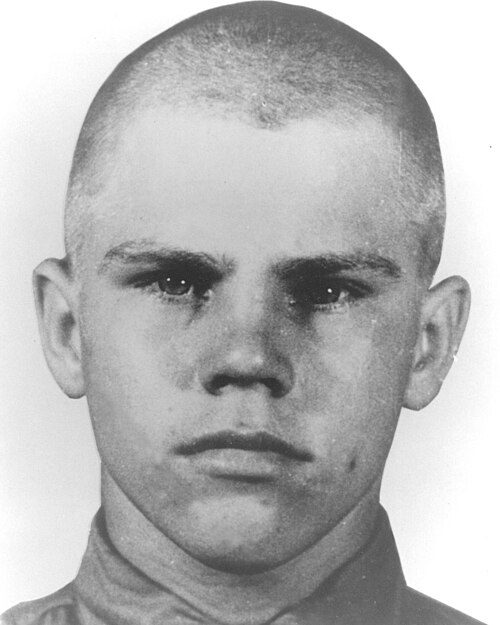
Staff Sergeant William Gordon Windrich, a Marine in the U.S. Marine Corps, was awarded the Medal of Honor posthumously for gallantry on December 1, 1950 in vinicity of Yudam-ni, Korea during the Korean War. At the time he was serving with Company I, 3d Battalion, 5th Marines, 1st Marine Division (Rein). Windrich was 29 years old.
One other service member also received the Medal of Honor for actions on the same day. The medal was presented on February 8, 1952.
Windrich was born on May 14, 1921 in Chicago, Cook County, Illinois. His Medal of Honor is credited to Hammond, Lake County, Indiana. Windrich died on December 2, 1950 in vinicity of Yudam-ni, Korea, at the age of 29. He is buried at Arlington National Cemetery in Arlington, Virginia.
Windrich is one of 153 Medal of Honor recipients from the Korean War and one of 75 credited to Indiana.
Official Medal of Honor citation
For conspicuous gallantry and intrepidity at the risk of his life above and beyond the call of duty as a platoon sergeant of Company I, in action against enemy aggressor forces the night of 1 December 1950. Promptly organizing a squad of men when the enemy launched a sudden, vicious counterattack against the forward elements of his company's position, rendering it untenable, S/Sgt. Windrich, armed with a carbine, spearheaded the assault to the top of the knoll immediately confronting the overwhelming forces and, under shattering hostile automatic-weapons, mortar, and grenade fire, directed effective fire to hold back the attackers and cover the withdrawal of our troops to commanding ground. With seven of his men struck down during the furious action and himself wounded in the head by a bursting grenade, he made his way to his company's position and, organizing a small group of volunteers, returned with them to evacuate the wounded and dying from the frozen hillside, staunchly refusing medical attention himself. Immediately redeploying the remainder of his troops, S/Sgt. Windrich placed them on the left flank of the defensive sector before the enemy again attacked in force. Wounded in the leg during the bitter fight that followed, he bravely fought on with his men, shouting words of encouragement and directing their fire until the attack was repelled. Refusing evacuation although unable to stand, he still continued to direct his platoon in setting up defensive positions until weakened by the bitter cold, excessive loss of blood, and severe pain, he lapsed into unconsciousness and died. His valiant leadership, fortitude, and courageous fighting spirit against tremendous odds served to inspire others to heroic endeavor in holding the objective and reflect the highest credit upon S/Sgt. Windrich and the U.S. Naval Service. He gallantly gave his life for his country.
Citation text: U.S. Government, public domain.
Other decorations and honors
Besides the Medal of Honor, William Gordon Windrich received:
Source: Wikidata. Gold chips link to our guide to that decoration.
Battles and campaigns
Also served in: World War II, Korean War.
Places
Veteran resources, cemeteries and meeting places in Indiana →
Timeline
- May 14, 1921Born in Chicago, Cook County, Illinois
- December 1, 1950Act of valor — vinicity of Yudam-ni, KoreaAge 29. Company I, 3d Battalion, 5th Marines, 1st Marine Division (Rein)
- December 2, 1950Died in vinicity of Yudam-ni, KoreaAge 29.
- February 8, 1952Medal of Honor presented posthumously
- Resting placeArlington National CemeteryArlington, Virginia
Biography
Staff Sergeant William Gordon Windrich (May 14, 1921 – December 2, 1950) was a United States Marine who was awarded the Medal of Honor posthumously for outstanding heroism as a platoon sergeant in the Battle of Chosin Reservoir during the Korean War. Staff Sergeant Windrich was killed in action the early morning of December 2, 1950 near Yudam-ni, North Korea, during a savage night battle with Chinese forces on Hill 1520. He had refused to be evacuated after being wounded twice, once when a grenade fragment ripped through his helmet.
From the Wikipedia article “William G. Windrich”, licensed under CC BY-SA 4.0. Read the full article →