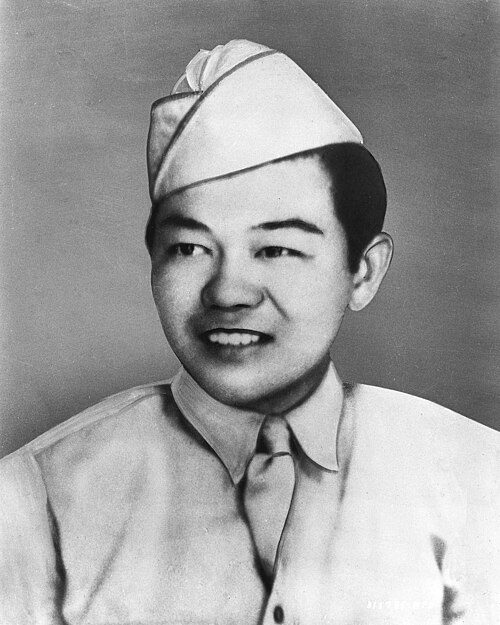
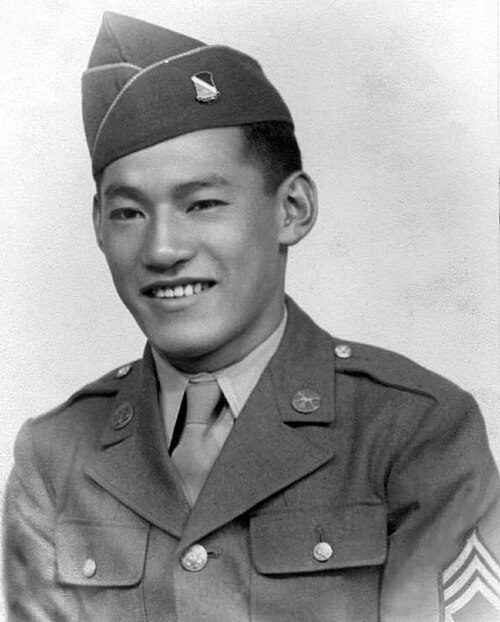
First Lieutenant Vernon Joseph Baker, a soldier in the U.S. Army, received the Medal of Honor for gallantry between April 5 and 6, 1945 near Castle Aghinolfi, Italy during World War II. At the time he was serving with Weapons Platoon, Company C, 370th Infantry Regiment, 92nd Infantry Division. Baker was 25 years old.
2 other service members also received the Medal of Honor for actions on the same day. The medal was presented on January 13, 1997, 51 years after the action — the White House (East Ballroom), presented by President William J. Clinton.
Baker was born on December 17, 1919 in Cheyenne, Laramie County, Wyoming. Baker died on July 13, 2010 in St. Maries, Idaho, at the age of 90. He is buried at Arlington National Cemetery in Arlington, Virginia.
Baker is one of 474 Medal of Honor recipients from World War II and one of 4 credited to Wyoming.
Official Medal of Honor citation
For conspicuous gallantry and intrepidity at the risk of his life above and beyond the call of duty:First Lieutenant Vernon J. Baker distinguished himself by extraordinary heroism in action on 5 and 6 April 1945. At 0500 hours on 5 April 1945, Lieutenant Baker advanced at the head of his weapons platoon, along with Company C's three rifle platoons, towards their objective; Castle Aghinolfi - a German mountain strong point on the high ground just east of the coastal highway and about two miles from the 370th infantry Regiment's line of departure. Moving more rapidly than the rest of the company, Lieutenant Baker and about 25 men reached the south side of a draw some 250 yards from the castle within two hours. In reconnoitering for a suitable position to set up a machine gun, Lieutenant Baker observed two cylindrical objects pointing out of a slit in a mount at the edge of a hill. Crawling up and under the opening, he stuck his M-1 into the slit and emptied the clip, killing the observation post's two occupants. Moving to another position in the same area, Lieutenant Baker stumbled upon a well-camouflaged machine gun nest, the crew of which was eating breakfast. He shot and killed both enemy soldiers. After Captain John F. Runyon, Company C's Commander joined the group, a German soldier appeared from the draw and hurled a grenade which failed to explode. Lieutenant Baker shot the enemy soldier twice as he tried to flee. Lieutenant Baker then went down into the draw alone. There he blasted open the concealed entrance of another dugout with a hand grenade, shot one German soldier who emerged after the explosion, tossed another grenade into the dugout and entered firing his sub-machine gun, killing two more Germans. As Lieutenant Baker climbed back out of the draw, enemy machine gun and mortar fire began to inflict heavy casualties among the group of 25 soldiers, killing or wounding about two-thirds of them. When expected reinforcements did not arrive, Captain Runyon ordered a withdrawal in two groups. Lieutenant Baker volunteered to cover the withdrawal of the first group, which consisted mostly of walking wounded, and to remain to assist in the evacuation of the more seriously wounded. During the second group's withdrawal, Lieutenant Baker, supported by covering fire from one of his platoon members, destroyed two machine gun positions (previously bypassed during the assault) with hand grenades. In all, Lieutenant Baker accounted for nine enemy dead soldiers, elimination of three machine gun positions, an observation post, and a dugout. On the following night, Lieutenant Baker voluntary led a battalion advance through enemy mine fields and heavy fire toward the division objective. Lieutenant Baker's fighting spirit and daring leadership were an inspiration to his men and exemplify the highest traditions of the military service.
Citation text: U.S. Government, public domain.
Other decorations and honors
Besides the Medal of Honor, Vernon Joseph Baker received:
Source: Wikidata. Gold chips link to our guide to that decoration.
Battles and campaigns
Also served in: World War II, Korean War.
Life beyond the battlefield
- Occupations: writer
Source: Wikidata.
Places
Veteran resources, cemeteries and meeting places in Wyoming →
Timeline
- December 17, 1919Born in Cheyenne, Laramie County, Wyoming
- April 5 - 6, 1945Act of valor — Near Castle Aghinolfi, ItalyAge 25. Weapons Platoon, Company C, 370th Infantry Regiment, 92nd Infantry Division
- January 13, 1997Medal of Honor presentedThe White House (East Ballroom), presented by President William J. Clinton
- July 13, 2010Died in St. Maries, IdahoAge 90.
- Resting placeArlington National CemeteryArlington, Virginia
Biography
Vernon Joseph Baker (December 17, 1919 – July 13, 2010) was a United States Army first lieutenant who was an infantry company platoon leader during World War II and a paratrooper during the Korean War. In 1997, he was awarded the Medal of Honor, the nation's highest military decoration for valor, for his actions on April 5–6, 1945, near Viareggio, Italy. Baker and six other Black Americans who served in World War II were formally awarded the Medal of Honor on January 12, 1997. A day later, Baker (the only living recipient) and representatives for the six other men were given the awards by President Bill Clinton at a ceremony in the White House in Washington, D.C.
From the Wikipedia article “Vernon Baker”, licensed under CC BY-SA 4.0. Read the full article →
Videos
Videos load from Vimeo only after you press play.