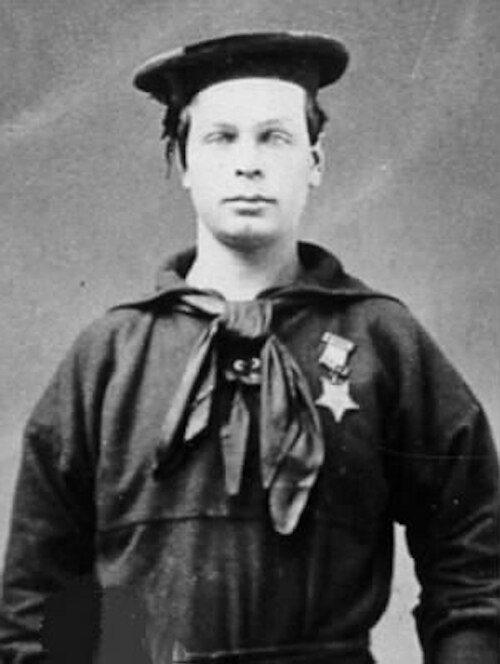
Boy Thomas S. Flood was a sailor in the U.S. Navy who received the Medal of Honor for his actions between April 24 and 25, 1862 in Forts Jackson & St. Philip, Louisiana during the Civil War. At the time he was serving with U.S.S. Pensacola. Flood was about 22 years old.
18 other service members also received the Medal of Honor for actions on the same day.
Flood was born in 1840 in Ireland — one of 258 recipients born in Ireland. His Medal of Honor is credited to New York.
Flood is one of 1,525 Medal of Honor recipients from the Civil War and one of 678 credited to New York.
Official Medal of Honor citation
Served on board the U.S.S. Pensacola in the attack on Forts Jackson and St. Philip and the taking of New Orleans, 24 and 25 April 1862. Swept from the bridge by a shell which wounded the signal quartermaster, Flood returned to the bridge after assisting the wounded man below and taking over his duties, "Performed them with coolness, exactitude and the fidelity of a veteran seaman. His intelligence and character cannot be spoken of too warmly.",,,,
Citation text: U.S. Government, public domain.
Battles and campaigns
Also served in: American Civil War.
Places
- Born: Ireland — map
Veteran resources, cemeteries and meeting places in New York →
Timeline
- 1840Born in Ireland
- April 24 - 25, 1862Act of valor — Forts Jackson & St. Philip, LouisianaAge about 22. U.S.S. Pensacola
Biography
Thomas S. Flood (born 1840, date of death unknown) was a Union Navy sailor in the American Civil War and a recipient of the U.S. military's highest decoration, the Medal of Honor, for his actions at the Battle of Forts Jackson and St. Philip. Born in 1840 in Ireland, Flood immigrated to the United States and was living in New York when he joined the U.S. Navy. He served during the Civil War on the USS Pensacola. At the Battle of Forts Jackson and St. Philip near New Orleans on April 24–25, 1862, he stood on Pensacola's bridge and acted as an aide to the executive officer, F.A. Roe.
From the Wikipedia article “Thomas S. Flood (Medal of Honor)”, licensed under CC BY-SA 4.0. Read the full article →