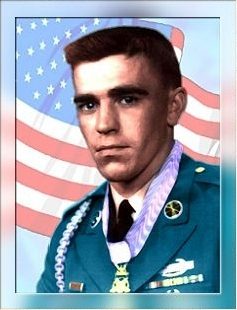
Specialist Fourth Class Robert Francis Stryker was a soldier in the U.S. Army who was awarded the Medal of Honor posthumously for his actions on November 7, 1967 near Loc Ninh, Republic of Vietnam during the Vietnam War. At the time he was serving with Company C, 1st Battalion, 26th Infantry, 1st Infantry Division. Stryker was 22 years old.
Stryker was killed in the action for which his medal was awarded. The medal was presented on November 4, 1969.
Stryker was born on November 9, 1944 in Auburn, Cayuga County, New York. His Medal of Honor is credited to Throop, Cayuga County, New York. He is buried at Pine Hill Cemetery in Throopsville, New York.
Stryker is one of 274 Medal of Honor recipients from the Vietnam War and one of 678 credited to New York.
Official Medal of Honor citation
For conspicuous gallantry and intrepidity at the risk of his life above and beyond the call of duty. Sp4c. Stryker, U.S. Army, distinguished himself while serving with Company C. Sp4c. Stryker was serving as a grenadier in a multicompany reconnaissance-in-force near Loc Ninh. As his unit moved through the dense underbrush, it was suddenly met with a hail of rocket, automatic-weapons, and small-arms fire from enemy forces concealed in fortified bunkers and in the surrounding trees. Reacting quickly, Sp4c. Stryker fired into the enemy positions with his grenade launcher. During the devastating exchange of fire, Sp4c. Stryker detected enemy elements attempting to encircle his company and isolate it from the main body of the friendly force. Undaunted by the enemy machine-gun and small-arms fire, Sp4c. Stryker repeatedly fired grenades into the trees, killing enemy snipers and enabling his comrades to sever the attempted encirclement. As the battle continued, Sp4c. Stryker observed several wounded members of his squad in the killing zone of an enemy claymore mine. With complete disregard for his safety, he threw himself upon the mine as it was detonated. He was mortally wounded as his body absorbed the blast and shielded his comrades from the explosion. His unselfish actions were responsible for saving the lives of at least six of his fellow soldiers. Sp4c. Stryker's great personal bravery was in keeping with the highest traditions of the military service and reflects great credit upon himself, his unit, and the U.S. Army.
Citation text: U.S. Government, public domain.
Wounds and death in action
What the citation records about his wounds:
He was mortally wounded as his body absorbed the blast and shielded his comrades from the explosion.
- Killed in action during the act for which the medal was awarded (November 7, 1967).
- Manner of death: death in battle
- Age at death: 22
- Resting place: Pine Hill Cemetery
Cause and manner of death: Wikidata.
Other decorations and honors
Besides the Medal of Honor, Robert Francis Stryker received:
Source: Wikidata. Gold chips link to our guide to that decoration.
Battles and campaigns
Also served in: Vietnam War.
Places
Veteran resources, cemeteries and meeting places in New York →
Timeline
- November 9, 1944Born in Auburn, Cayuga County, New York
- November 7, 1967Act of valor — near Loc Ninh, Republic of VietnamAge 22. Company C, 1st Battalion, 26th Infantry, 1st Infantry Division Killed in action.
- November 4, 1969Medal of Honor presented posthumously
- Resting placePine Hill CemeteryThroopsville, New York
Biography
Robert Francis Stryker (November 9, 1944 – November 7, 1967) was a United States Army soldier who posthumously received the Medal of Honor for his actions during the Vietnam War. Vice President Spiro Agnew awarded the medal in a ceremony that also honored John Andrew Barnes III and Fr. Charles J. Watters. The Stryker combat vehicle is named in his and Pfc. Stuart S. Stryker's honor (no relation). Stryker joined the army in 1963.
From the Wikipedia article “Robert F. Stryker”, licensed under CC BY-SA 4.0. Read the full article →
Named in his honor
- Stryker — combat vehicle model