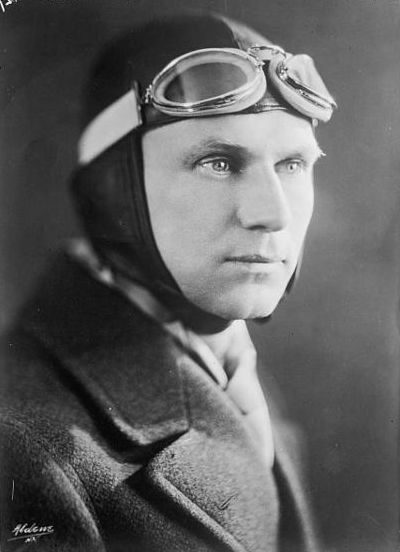
Serving as a sailor in the U.S. Navy, Commander Richard Evelyn Byrd Jr. received the Medal of Honor for his actions on May 9, 1926 in Spitsbergen, Norway — a peacetime act of courage recognized in the Interim 1920 - 1940 period. Byrd was 37 years old.
One other service member also received the Medal of Honor for actions on the same day. The medal was presented on February 25, 1927 — the White House, presented by Pres. Calvin Coolidge. He later rose to the rank of Rear Admiral.
Byrd was born on October 25, 1888 in Winchester, Frederick County, Virginia. His Medal of Honor is credited to Virginia. Byrd died on March 11, 1957 in Boston, Massachusetts, at the age of 68. He is buried at Arlington National Cemetery in Arlington, Virginia. His medal is held by Marshall Museum, Virginia Military Institute (star design), Lexington, VA.
Official Medal of Honor citation
For distinguishing himself conspicuously by courage and intrepidity at the risk of his life, in demonstrating that it is possible for aircraft to travel in continuous flight from a now inhabited portion of the earth over the North Pole and return.
Citation text: U.S. Government, public domain.
Other decorations and honors
Besides the Medal of Honor, Richard Evelyn Byrd Jr. received:
Source: Wikidata. Gold chips link to our guide to that decoration.
Battles and campaigns
Also served in: World War I, World War II.
Life beyond the battlefield
- Occupations: admiral, oceanographer, explorer, polar explorer
- Education: University of Virginia, United States Naval Academy, Virginia Military Institute
Source: Wikidata.
Places
Veteran resources, cemeteries and meeting places in Virginia →
Timeline
- October 25, 1888Born in Winchester, Frederick County, Virginia
- May 9, 1926Act of valor — Spitsbergen, NorwayAge 37.
- February 25, 1927Medal of Honor presentedThe White House, presented by Pres. Calvin Coolidge
- March 11, 1957Died in Boston, MassachusettsAge 68.
- Resting placeArlington National CemeteryArlington, Virginia
Biography
Richard Evelyn Byrd Jr. (October 25, 1888 – March 11, 1957) was an American naval officer, and pioneering aviator, polar explorer, and organizer of polar logistics. Aircraft flights in which he served as a navigator and expedition leader crossed the Atlantic Ocean, a segment of the Arctic Ocean, and a segment of the Antarctic Plateau. He is also known for discovering Mount Sidley, the largest dormant volcano in Antarctica. Byrd claimed to be the first to reach both the North and South Poles by air. However, there is some controversy as to whether he was actually the first person to reach the North Pole.
From the Wikipedia article “Richard E. Byrd”, licensed under CC BY-SA 4.0. Read the full article →
Named in his honor
- Byrd — lunar crater
- Byrd — Mars crater, impact crater
- Byrd Canyon — landform
- Byrd Glacier — ice stream
- Byrd Polar and Climate Research Center — academic institution, research institute
- Byrdstraat — street
- Cape Byrd — headland, peninsula
- USNS Richard E. Byrd — bulk carrier
- USS Richard E. Byrd — guided missile destroyer