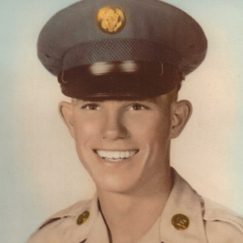
Serving as a soldier in the U.S. Army, Specialist Fourth Class Nicholas Joseph Cutinha was awarded the Medal of Honor posthumously for his actions on March 2, 1968 near Gia Dinh, Republic of Vietnam during the Vietnam War. At the time he was serving with Company C, 4th Battalion, 9th Infantry Regiment, 25th Infantry Division. Cutinha was 23 years old.
Cutinha was killed in the action for which his medal was awarded. The medal was presented on April 7, 1970, 2 years after the action — the White House, presented by Pres. Richard M. Nixon to his family.
Cutinha was born on January 13, 1945 in Fernandina Beach, Nassau County, Florida. His Medal of Honor is credited to Coral Gables, Dade County, Florida. He is buried at Fort Denaud Cemetery in LaBelle, Florida. His medal is held by American Legion Post 130, LaBelle, FL.
Cutinha is one of 274 Medal of Honor recipients from the Vietnam War and one of 24 credited to Florida.
Official Medal of Honor citation
For conspicuous gallantry and intrepidity in action at the risk of his life above and beyond the call of duty. While serving as a machine gunner with Company C, Sp4c. Cutinha accompanied his unit on a combat mission near Gia Dinh. Suddenly his company came under small-arms, automatic-weapons, mortar, and rocket-propelled grenade fire, from a battalion-size enemy unit. During the initial hostile attack, communications with the battalion was lost and the company commander and numerous members of the company became casualties. When Sp4c. Cutinha observed that his company was pinned down and disorganized, he moved to the front with complete disregard for his safety, firing his machine gun at the charging enemy. As he moved forward he drew fire on his own position and was seriously wounded in the leg. As the hostile fire intensified and half of the company was killed or wounded, Sp4c. Cutinha assumed command of all the survivors in his area and initiated a withdrawal while providing cover fire for the evacuation of the wounded. He killed several enemy soldiers but sustained another leg wound when his machine gun was destroyed by incoming rounds. Undaunted, he crawled through a hail of enemy fire to an operable machine gun in order to continue the defense of his injured comrades who were being administered medical treatment. Sp4c. Cutinha maintained this position, refused assistance, and provided defensive fire for his comrades until he fell mortally wounded. He was solely responsible for killing 15 enemy soldiers while saving the lives of at least nine members of his own unit. Sp4c. Cutinha's gallantry and extraordinary heroism were in keeping with the highest traditions of the military service and reflect great credit upon himself, his unit, and the U.S. Army.
Citation text: U.S. Government, public domain.
Wounds and death in action
What the citation records about his wounds:
He killed several enemy soldiers but sustained another leg wound when his machine gun was destroyed by incoming rounds.
Cutinha maintained this position, refused assistance, and provided defensive fire for his comrades until he fell mortally wounded.
- Killed in action during the act for which the medal was awarded (March 2, 1968).
- Age at death: 23
- Resting place: Fort Denaud Cemetery
Battles and campaigns
Also served in: Vietnam War.
Places
Veteran resources, cemeteries and meeting places in Florida →
Timeline
- January 13, 1945Born in Fernandina Beach, Nassau County, Florida
- March 2, 1968Act of valor — near Gia Dinh, Republic of VietnamAge 23. Company C, 4th Battalion, 9th Infantry Regiment, 25th Infantry Division Killed in action.
- April 7, 1970Medal of Honor presented posthumouslyThe White House, presented by Pres. Richard M. Nixon to his family
- Resting placeFort Denaud CemeteryLaBelle, Florida
Biography
Nicholas Joseph Cutinha (January 13, 1945 – March 2, 1968) was a United States Army soldier and a recipient of the United States military's highest decoration—the Medal of Honor—for his actions in the Vietnam War.
From the Wikipedia article “Nicholas J. Cutinha”, licensed under CC BY-SA 4.0. Read the full article →