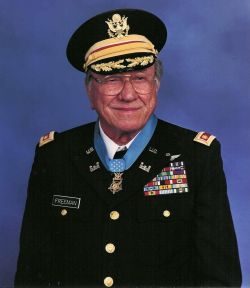
Major Bruce P. Crandall, a soldier in the U.S. Army, received the Medal of Honor for gallantry on November 14, 1965 at Landing Zone X-Ray, Ia Drang Valley, Vietnam during the Vietnam War. At the time he was serving with 229th Assault Helicopter Battalion, 1st Cavalry Division (Airmobile). Crandall was 32 years old.
2 other service members also received the Medal of Honor for actions on the same day. The medal was presented on February 26, 2007, 41 years after the action — the White House, presented by President George W. Bush. He later rose to the rank of Colonel.
Crandall was born on February 17, 1933 in Olympia, Thurston County, Washington. Crandall died on May 31, 2026 in Tempe, Arizona, at the age of 93.
Crandall is one of 274 Medal of Honor recipients from the Vietnam War and one of 40 credited to Washington.
Official Medal of Honor citation
Major Bruce Crandall distinguished himself by extraordinary heroism as a Flight Commander in the Republic of Vietnam while serving with Company A, 229th Assault Helicopter Battalion, 1st Cavalry Division (Airmobile). On 14 November 1965, his flight of sixteen helicopters was lifting troops for a search and destroy mission from Plei Me, Vietnam, to Landing Zone X-Ray in the Ia Drang Valley. On the fourth troop lift, the enemy had Landing Zone X-Ray targeted. As Major Crandall and the first eight helicopters landed to discharge troops on his fifth troop lift, his unarmed helicopter came under such intense enemy fire that the ground commander ordered the second flight of eight aircraft to abort their mission. As Major Crandall flew back to Plei Me, his base of operations, he determined that the ground commander of the besieged infantry battalion desperately needed more ammunition. Major Crandall then decided to adjust his base of operations to Artillery Firebase Falcon in order to shorten the flight distance to deliver ammunition and evacuate wounded soldiers. While medical evacuation was not his mission, he immediately sought volunteers and with complete disregard for his own personal safety, led the two aircraft to Landing Zone X-Ray. Despite the fact that the landing zone was still under relentless enemy fire, Major Crandall landed and proceeded to supervise the loading of seriously wounded soldiers aboard the aircraft. Major Crandall’s voluntary decision to land under the most extreme fire instilled in the other pilots the will and spirit to continue to land their own aircraft, and in the ground forces the realization that they would be resupplied and that friendly wounded would be promptly evacuated. This greatly enhanced morale and the will to fight at a critical time. After his first medical evacuation, Major Crandall continued to fly into and out of the landing zone throughout the day and into the evening. That day he completed a total of 22 flights, most under intense enemy fire, retiring from the battlefield only after all possible service had been rendered to the Infantry battalion. His actions provided critical resupply of ammunition and evacuation of the wounded. Major Crandall’s daring acts of bravery and courage in the face of an overwhelming and determined enemy are in keeping with the highest traditions of the military service and reflect great credit upon himself, his unit and the United States Army.
Citation text: U.S. Government, public domain.
Other decorations and honors
Besides the Medal of Honor, Bruce P. Crandall received:
Source: Wikidata. Gold chips link to our guide to that decoration.
Battles and campaigns
Also served in: World War II, United States occupation of the Dominican Republic, Korean War, Vietnam War.
Life beyond the battlefield
- Occupations: helicopter pilot
- Education: Defense Language Institute, University of Nebraska–Lincoln, Olympia High School
Source: Wikidata.
Places
Veteran resources, cemeteries and meeting places in Washington →
Timeline
- February 17, 1933Born in Olympia, Thurston County, Washington
- November 14, 1965Act of valor — Landing Zone X-Ray, Ia Drang Valley, VietnamAge 32. 229th Assault Helicopter Battalion, 1st Cavalry Division (Airmobile)
- February 26, 2007Medal of Honor presentedThe White House, presented by President George W. Bush
- May 31, 2026Died in Tempe, ArizonaAge 93.
Biography
Bruce Perry Crandall (February 17, 1933 – May 31, 2026) was a United States Army officer who received the Medal of Honor for his actions as a pilot during the Battle of Ia Drang on November 14, 1965, in South Vietnam. During the battle, he flew 22 missions in a Bell Huey helicopter into enemy fire to evacuate more than 70 wounded and bring ammunition and supplies to United States forces. His actions in the battle of the Ia Drang valley were portrayed by actor Greg Kinnear in the Mel Gibson film, We Were Soldiers. By the end of the Vietnam War, he had flown more than 900 combat missions.
From the Wikipedia article “Bruce P. Crandall”, licensed under CC BY-SA 4.0. Read the full article →
Videos
Videos load from Vimeo only after you press play.
Further reading
- MOH recipient Bruce Crandall shares solemn, humorous storieslegion.org · 2021